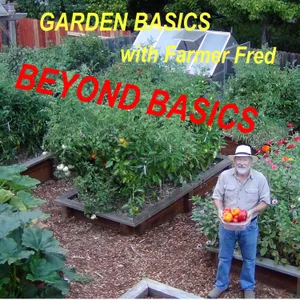
Free Daily Podcast Summary
Beyond the Garden Basics: Daily Summaries Delivered
by Farmer Fred
Picking up where the Garden Basics podcast left off.
Latest Episodes
The most recent episodes — sign up to get AI-powered summaries of each one.
- 2 days ago15 min
Getting the Soil Ready for Cool Season Plants
In today’s podcast, Sacramento County Master Gardener and vegetable expert Gail Pothour explains how to transition garden beds and raised beds from warm-season crops to cool-season plantings. We talk about clearing out tomatoes, peppers, squash, cucumbers, and melons at the end of summer: should you pull out the plant or cut it off at the soil line? It depends. Gail will explain, emphasizing the importance of checking the roots of summer garden plants if they were victims of pests or disease. Gail mentions the advantages of adding compost and lightly working it into the soil rather than doing heavy tilling.She also discusses winter cover crops such as mustard mix, crimson clover, and soil-builder blends of cover crops, along with how and when to cut them down so they improve the soil.Here are the main points from the podcast:* Before you rip out summer crops and jump straight into fall planting, take a beat and deal with your soil first. It makes a real difference.* When you pull spent tomatoes and squash, check a cross section of the main stem for browning. That’s a sign of fusarium wilt, and it means the disease could spread to your other beds.* Pull the roots all the way out instead of cutting plants at soil level. Yes, leaving roots to decompose feeds beneficial bacteria, but you need to see the roots to check for root knot nematodes. Gail’s team found nematodes in a bed that never had that problem before.* Skip granular fertilizers for fall planting. It’s slow release, and cool season crops need something that acts fast. A liquid feed, such as fish emulsion or kelp, works better. And honestly, you might not even need it. Let the plant tell you if it’s hungry through the yellowing leaves.* Work a couple inches of compost into the bed gently. No tilling needed. Just slide a garden fork in (a broadfork is ideal), rock it a bit, and let the compost filter down naturally so you’re not disturbing the soil structure too much. That helps preserve the existing beneficial soil microbiology.* Cover crops are a smart move if you’re not planting edibles in every bed this winter. Try a mustard mix (it actually helps suppress nematode populations), crimson clover for nitrogen fixing, or a soil builder blend of oats, vetch, peas and bell beans.* Timing matters with cover crops. Cut them down while they’re flowering. That’s when the nitrogen benefit to your soil is highest. Let them go to seed and most of that nitrogen gets diverted into the beans or pods instead.* Fine cover crops like mustard and crimson clover can be left right on the soil as mulch. Woodier ones like bell beans and the soil builder mix need to be chopped up first, or they’ll take forever to break down.* With a wet winter predicted, mulch is doing double duty. It protects against erosion and it cushions the soil from compaction when heavy rain pounds down on bare dirt.* Only use disease-free plant material for mulch or compost. If you’re dealing with powdery mildew, fusarium, or nematodes, that spent plant material needs to go in the trash, not back into your growing space.* Check thick foliage plants like tomatoes for pest eggs before composting them. Leaf-footed bug eggs and similar pests will happily overwinter in your compost pile and come right back to suck on your plants next season.* Great low-maintenance winter crops for milder zones include lettuce, peas, fava beans, beets, carrots, bok choy, cabbage, kohlrabi, and brussels sprouts.* Tokyo Bekana Chinese cabbage is worth growing even though it’s technically a brassica. It’s soft and lime green with a thin leaf, so it eats more like lettuce than cabbage.* Soak pea seeds overnight in tepid water before planting to help speed germination.* Beet and chard seeds benefit from a shorter (2-4 hours) soaking in water too. That soaking helps break down those seeds’ natural germination inhibitor, speeding the germination process.* Carrot seeds are notoriously slow and tricky, sometimes taking three weeks to germinate. Cover them lightly with compost, lay a thin row cover or burlap on top, and keep the bed consistently moist. If carrot seeds dry out mid-germination, they die. More info here about growing carrots.* Soaking carrot seeds for a few
- 5 days ago17 min
Cool Season Garden PLANNING Time is Here
In today’s podcast, Master Gardener and vegetable expert Gail Pothour talks about cool season greens to grow in your backyard garden during the fall and winter. There’s a human-corrected transcript at the bottom of this newsletter. Among the main points in our conversation:* Cool season vegetable gardening works especially well in USDA zones 7, 8, 9, and 10; but in colder areas you can grow food nearly year round if you plan for it.* Late summer into early fall is the time to pull tired summer crops, work in some compost and fertilizer, and get cool season seeds or transplants in the ground while the soil is still warm.* Most cool season crops mature fast, often in 40 to 60 days, so you can have a real harvest within about two months.* A cold frame, basically a raised bed with a hinged translucent lid, protects plants from frost and heavy rain, and doubles as an insect barrier when you stretch screen across the open top during the day. A must for colder climates.* Floating row covers are one of the most useful tools this time of year. It keeps cabbage loopers and imported cabbage worms from laying eggs on brassicas like kale, broccoli, cauliflower and radishes, and it can even help slow down snails and slugs.* Row covers also help slow-to-germinate seeds like carrots and beets by keeping the soil consistently moist while they sprout.* Beginners are usually better off buying transplants than starting from seed, since crops like lettuce and carrots can be tricky to germinate from seed.* When buying transplants, choose smaller, sturdy, healthy looking plants rather than tall or root-bound ones, since cool season crops don’t love having their roots disturbed.* If you can’t plant right away, move six pack transplants into their own four inch pots with fresh potting soil first. It gives them a chance to build stronger roots before they go in the ground.* For lettuce, stick with loose leaf types like romaine and butter lettuce rather than Iceberg, which struggles to head up properly in home gardens in the warmer areas of USDA Zone 9. Favorites mentioned include Salanova red butter, Pomegranate Crunch, Lola Rossa and the heirloom Forellenschluss (also known as “speckled trout” or “flashy trout back”).* Swiss chard, especially “Bright Lights” with its multicolored stems, is easy to grow, good looking enough for a flower bed, and often overwinters into the next summer.* For kale, go with edible types like Lacinato (dinosaur kale), Tuscan baby leaf, Red Bor, and Red Russian rather than the tough, purely ornamental kales.* Asian greens like Pak Choi and Bok Choy, including a fast growing All America Selection called Asian Delight, are quick to harvest and tend to have fewer pest problems because they’re in the ground for such a short time.* Once brassicas bolt in late winter, the flowers are a magnet for bees and other beneficial insects, and the young flower shoots on kale can be cut and cooked just like broccolini.* For spinach, look for less crinkled varieties like Tyee, which are easier to clean, and treat it as a fast, short lived crop worth succession planting rather than one you let linger in the garden. This is a public episode. If you'd like to discuss this with other subscribers or get access to bonus episodes, visit gardenbasics.substack.com/subscribe
- 1 weeks ago22 min
Pruning Blackberries
In today’s podcast, we talk with Sacramento County Master Gardener Michael Stinson about the when, how and why of pruning blackberry vines. Don’t want to listen? Here’s a summary. A complete transcript is at the bottom of this newsletter.Pruning Blackberries: Key PointsFrom a conversation with Sacramento County Master Gardener Michael Stinson• Blackberry plants are perennials that can live 15 to 20 years, but each individual cane only last around two seasons, with a notable exception.• First year canes are called primocanes. Second year canes, the ones that flower and fruit, are floricanes. Fall pruning is all about removing the floricanes. This is a public episode. If you'd like to discuss this with other subscribers or get access to bonus episodes, visit gardenbasics.substack.com/subscribe
- 1 weeks ago18 min
Controlling Puncturevine Weed and Liquidambar Tree Seeds
We tackle two prickly topics: the spiky, caltrop-like seed balls of puncturevine weed and the “sputniks” of liquidambar (sweet gum) trees. Yes, those sharply pointed spheres that fly in the autumn breeze do resemble Eisenhower-era, low-earth orbiting Russian weapons of no destruction. This is a public episode. If you'd like to discuss this with other subscribers or get access to bonus episodes, visit gardenbasics.substack.com/subscribe
- 2 weeks ago25 min
Saving Homegrown Tomato Seeds...and more about Tomatoes!
Collecting, Storing and Using Home-Saved Tomato SeedsIf you want to save seeds of a particular tomato variety, remember that many varieties are hybrids; they may not necessarily come back with the same traits as the tomato you enjoyed last season. According to Penn State Extension, the result of these crosses usually only lasts one generation, so the seeds harvested from hybrids may produce disappointing results.Or, may not be a disappointment. Tomato flowers are primarily wind-pollinated. So, those plants grown in isolation or covered with insect netting during their flowering period may provide satisfactory results. Experiment! One tip: note the tastiest varieties in your garden right now, in September. Save those seeds. Then, next year, put the plant that germinates far away from your other tomato varieties.Open pollinated or heirloom tomato seeds are fine for saving, as long as they are grown 10-30 feet away from any other varieties. For best results: save the seeds from tomatoes that are overly ripe; rinse off as much of the flesh and protective gelatinous coating from the seeds as is possible. Then, soak the seeds in a jar of water for a couple of days to remove the rest of the coating. The seeds will sink to the bottom, the gel will float. Discard the gel, remove the seeds and let dry on a paper towel. Then, store in an airtight container in a cool, dry location.Tomato seed saving techniques can vary. Here’s a sampling of methods from across the country.From Penn State: This is a public episode. If you'd like to discuss this with other subscribers or get access to bonus episodes, visit gardenbasics.substack.com/subscribe
- 3 weeks ago9 min
Heat-Tolerant Roses
“Of all flowers, methinks rose is best”. Shakespeare said that. He lived in Stratford-upon-Avon, about halfway between London and Birmingham, England. However, the roses he saw 600 years ago never endured 100 degree heat…until recently.Although roses were found originally in Central Asia, they spread quickly throughout the Northern Hemisphere between the 12th and 18th centuries.Those old roses wouldn’t stand a chance in the heatwaves of the 21st century, succumbing to scorched flowers, leaves, and buds…as well as dying off due to a lack of regular watering in drought-effected areas.Of course, hybridization of roses in the 19th, 20th and 21st centuries has created varieties that can withstand a number of modern ailments, including air pollution.So, what are the modern roses that can take the heat, when temperatures hit 100 degrees for several days in a row? What are the traits of a heat-tolerant rose?Master Rosarian Debbie Arrington of the Sacramento Rose Society (and the Sacramento Digs Gardening blog) enumerated several in the podcast at the top of this page. Sacramento (City Motto: “At Least It’s a Dry Heat”) is no stranger to prolonged, triple digit heat waves, which can occur anytime from May through September. So, the area is a good testing ground for roses that maintain their color, health and vigor throughout spring, summer - and sometimes fall - heatwaves. One trait many of these have in common: these rose bushes produce light-colored blooms of white, pink or yellow. Most red roses, Arrington explains, absorb more of the heat, and will be among the first to scorch. Sorry about that, Bobby Darin.Among the roses on Debbie Arrington’s list of heat-tolerant roses: This is a public episode. If you'd like to discuss this with other subscribers or get access to bonus episodes, visit gardenbasics.substack.com/subscribe
- 3 weeks ago14 min
Dealing with Tomato Blossom End Rot
Blossom end rot is generally considered the most common tomato problem for backyard gardeners in the US. It causes a dark, sunken, leathery spot on the bottom of the fruit, and it’s usually caused by inconsistent watering (not actually a soil calcium deficiency in most cases) that disrupts calcium uptake in the plant.For those of you at home keeping score, close runners-up are early blight and septoria leaf spot, both fungal diseases that cause yellowing and spotted leaves, especially in humid climates.The big difference between blossom end rot and all those runner-up problems? Blossom end rot is an abiotic disorder, not something you can blame on a disease or an insect (“Abiotic disorder” is plant nerd talk for “it’s the gardener’s fault”). This is a public episode. If you'd like to discuss this with other subscribers or get access to bonus episodes, visit gardenbasics.substack.com/subscribe
- Aug 21, 202614 min
What To Do When a Wildfire Approaches Your Home
Today’s podcast and newsletter of Beyond the Garden Basics is something a bit different, but very important: what to do around your home, both inside and outside, if a wildfire is in the area, and you have a few hours before an evacuation becomes mandatory.That was the topic in a Youtube video presented by Todd Lando, a battalion chief and wildfire mitigation specialist for the Central Marin Fire District. Marin County is in northern california, just north of San Francisco, a bucolic area with hills, mountains and forests abutting the Pacific Ocean. As you might imagine, especially with its proximity to San Francisco, it is one of the more heavily populated areas that can be described as the urban-wildland interface, where suburbia meets a very fire prone area. More information can be found at the website fire safe marin dot org.Among the practical tips that Lando discusses in the video include what should be done to prepare if a wildfire is getting to be an imminent situation. Of course, if you hear the order to evacuate immediately, you do want to leave immediately. Here’s a summary of his advice. This is a public episode. If you'd like to discuss this with other subscribers or get access to bonus episodes, visit gardenbasics.substack.com/subscribe
Get Beyond the Garden Basics summaries in your inbox
Free AI-powered daily recaps. Key takeaways, quotes, and mentions — in a 5-minute read.
Get Free Summaries →Free forever for up to 3 podcasts. No credit card required.
You Might Also Like
Listeners also like.

The Beginner's Garden with Jill McSheehy
A practical guide for new gardeners, breaking down gardening basics and terminology to help beginners grow confidently.

The joe gardener Show - Organic Gardening - Vegetable Gardening - Expert Garden Advice From Joe Lamp'l
Joe Lamp'l shares practical, organic gardening advice focused on growing food and sustainable practices for gardeners of all skill levels.

BBC Gardeners’ World Magazine Podcast
Expert gardening advice, seasonal tips, and global garden travels from BBC Gardeners’ World Magazine.
Gardening with the RHS
Seasonal gardening advice from RHS experts, covering planting, design, pest control, and flower show insights for all skill levels.

Black in the Garden
Explores the intersection of Black culture and gardening through conversations about plants, identity, and community.

The Beet: A Podcast For Plant Lovers
Explores gardening from basics to advanced techniques, featuring expert insights and innovations in plant science and agriculture.

Gardeners' Corner
Weekly gardening advice and insights from across the province, featuring visits to diverse gardens and practical tips for enthusiasts.
Everyday Homesteading
A veteran homesteading couple shares practical methods for growing, cooking, and preserving food for families with limited time.
Learn Cut Flower Growing | Lessons From a Seasoned Flower Farmer
A seasoned flower farmer shares practical advice and insights on growing and selling cut flowers, from planting to harvest.
Pioneering Today Podcast - Homesteading in a Modern World
Homesteading skills like gardening, food preservation, livestock care, and natural remedies for a self-sufficient life in the modern world.
Gardeners' Question Time
Horticultural experts answer audience gardening questions in weekly live recordings from various locations.

Growing Cut Flowers
Two flower growers share practical tips, expert interviews, and personal experiences to help you cultivate stunning cut flowers.
About Beyond the Garden Basics
Picking up where the Garden Basics podcast left off.
Customized Recaps
AI-powered recaps with compact key takeaways, quotes, and insights.
Straight to Your Inbox
Get key takeaways from Beyond the Garden Basics in a 5-minute read.
Save Hours Every Week
Stay current on your favorite podcasts without falling behind.
Frequently Asked Questions
What is Podzilla's Beyond the Garden Basics daily summary?
It's a free AI-powered email that summarizes new episodes of Beyond the Garden Basics as soon as they're published. You get the key takeaways, notable quotes, and links & mentions — all in a quick read.
How does the Beyond the Garden Basics podcast summary work?
When a new episode drops, our AI transcribes and analyzes it, then generates a personalized summary tailored to your interests and profession. It's delivered to your inbox every morning.
Is this an official Beyond the Garden Basics product?
No. Podzilla is an independent service that summarizes publicly available podcast content. We're not affiliated with or endorsed by Farmer Fred.
Can I get summaries of other podcasts too?
Absolutely! The free plan covers up to 3 podcasts. Upgrade to Pro for 15, or Premium for 50. Browse our full catalog at /podcasts.
How often does Beyond the Garden Basics release new episodes?
Beyond the Garden Basics publishes 2x weekly. Our AI generates a summary within hours of each new episode.
What topics does Beyond the Garden Basics cover?
Beyond the Garden Basics covers topics including Leisure, Education, How To, Garden, Home & Garden. Our AI identifies the specific themes in each episode and highlights what matters most to you.
Start getting Beyond the Garden Basics summaries tomorrow morning.
Free forever for up to 3 podcasts. No credit card required.
Free forever for up to 3 podcasts. No credit card required.