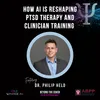
How AI Is Reshaping PTSD Therapy and Clinician Training with Dr. Philip Held
In this episode of Beyond the Couch, Dr. Ernest Wayde interviews Dr. Philip Held, a clinical psychologist and researcher focused on improving PTSD treatment outcomes through AI and accelerated therapy models. The conversation explores how Dr. Held’s team developed “Socrates 2.0,” a multi-agent AI system designed to support cognitive restructuring through Socratic dialogue alongside evidence-based therapy.Dr. Held explains how the system uses multiple AI agents to supervise and improve therapeutic conversations in real time, reducing looping behaviors and improving the quality of AI-assisted interactions. The discussion highlights how veterans are using AI as a practice space before therapy sessions, how clinicians are beginning to use these tools for supervision and training, and why validation, safety testing, and clear guardrails are critical as AI becomes more integrated into mental health care.The episode also explores the future of AI-assisted clinician training, ethical considerations around validation standards, and why curiosity and responsible experimentation are essential as psychology adapts to rapidly advancing technologies.Takeaways:Multi-Agent AI Can Improve the Quality of Therapeutic Conversations.AI Tools Can Help Veterans Practice Difficult Conversations Before Therapy Sessions.Validation, Safety Testing, and Guardrails Are Essential for Mental Health AI Tools.AI Is Best Used as a Support Tool Rather Than a Replacement for Clinicians.Clinicians Are Beginning to Use AI for Supervision, Roleplay, and Skill Development.Connect with Dr. Philip HeldLinkedIn: https://www.linkedin.com/in/philip-held-phd/Website: https://roadhomeprogram.org/Connect With Ushttps://www.waydeai.com/https://www.facebook.com/waydeaihttps://www.linkedin.com/company/wayde-ai/info@waydeai.comSubcribehttps://the-waydeai-brief.beehiiv.com/Chapters:00:00 - Intro02:24 - Dr. Philip Held’s journey into AI and psychology05:58 - How Socratic dialogue works inside the AI tool08:24 - Multi-agent AI supervision inspired by clinical training10:05 - What success looks like for Socrates 2.011:30 - The challenge of measuring “good enough” in AI therapy14:48 - How AI is changing traditional therapy methods17:00 - How veterans responded to using the AI tool19:33 - Why validating AI mental health tools matters23:02 - What responsibilities still belong to clinicians25:40 - Clinicians’ reactions to AI-assisted therapy tools27:33 - Future AI applications for clinician training and supervision30:28 - The need for AI benchmarks, boundaries, and guardrails34:36 - What “validation” really means in AI mental health35:45 - Dr. Philip Held’s advice on staying curious about AI
Podzilla Summary coming soon
Sign up to get notified when the full AI-powered summary is ready.
Free forever for up to 3 podcasts. No credit card required.
Listen to This Episode
More from Beyond the Couch: AI in Psychology

Teaching Students to Think With AI, Not Around It with Dr. David Williamson Shaffer

AI, Therapy & Human Connection: What Psychologists Need to Know with Dr. Page Anderson

Parenting Through the AI Era: What Every Parent Needs to Know with Dr. Amber Childs

How AI Is Changing Human Relationships and Mental Health with Dr. Rachel Wood
Get summaries like this every morning.
Free AI-powered recaps of Beyond the Couch: AI in Psychology and your other favorite podcasts, delivered to your inbox.
Free forever for up to 3 podcasts. No credit card required.