Free Daily Podcast Summary
Beyond Proof: Stories in Mathematics: Daily Summaries Delivered
by The Turing App
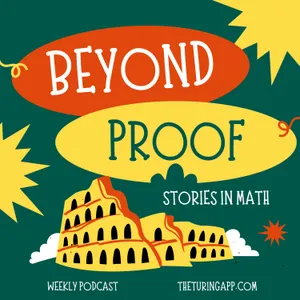
Stories in Math is the podcast I wanted when I was younger and math felt like this sealed-off world I couldn’t get into. Math has always been a very human thing. It’s people arguing, guessing, getting stuck, getting lucky, and sometimes accidentally stepping into an idea so big it changes everything. This show is a collection of those stories, that bring out the journey and stories behind mathematical discoveries. Stories in Math is for anyone who’s curious. If you love math, you’ll get the backstory you didn’t get in class. If you’ve always felt shut out by math, this is a way in.
Latest Episodes
The most recent episodes — sign up to get AI-powered summaries of each one.
- 5 days ago46 min
How Self Driving Cars Work?
From Leonardo da Vinci’s 15th-century conceptual designs and Francis Houdina’s radio-controlled "American Wonder" in 1925 to General Motors' visionary Futurama exhibit at the 1939 New York World's Fair, the pursuit of the autonomous vehicle has evolved over centuries. In this episode, we explore the history and mathematical foundations of self-driving cars, tracing how the paradigm shifted from embedding magnetic cables and detector circuits into intelligent highways to building smart, self-contained vehicles. We examine the breakthroughs of Ernst Dickmanns's VaMoRs van and Carnegie Mellon's Navlab, as well as the crucible of the 2000s DARPA Grand and Urban Challenges that birthed the modern commercial race. Finally, we break down the Society of Automotive Engineers' six distinct levels of automation (J3016), from basic driver assistance to fully autonomous robotaxis operating on city streets.
- 1 weeks ago42 min
How Deepfake Detection Works?
When comedian Jordan Peele released a viral video in April 2018 featuring an uncanny, AI-generated avatar of Barack Obama delivering a startling warning, it marked the arrival of deepfakes—digital forgeries that are invisible at first glance. In this episode, we explore the origins and escalation of deepfake technology, tracking how Ian Goodfellow’s 2014 invention of Generative Adversarial Networks (GANs) at the Université de Montréal provided the foundational architecture for hyper-realistic face-swapping and voice synthesis. We examine early defensive responses, such as detecting missing blinks, and look at how digital forensics adapted mathematical tools like Bayesian filtering, eigenfaces, and gradient descent optimizations to spot microscopic editing artifacts. Finally, we investigate the turning point of the 2019 Deepfake Detection Challenge sponsored by Facebook, and how feature-based pipelines leverage lighting inconsistencies, head-pose angles, and audio-visual synchronization to combat the explosive growth of synthetic media.
- 2 weeks ago19 min
Will AI Put Mathematicians out of Job?
When Google DeepMind and OpenAI models won gold medals at the International Mathematical Olympiad by solving five out of six complex problems, it signaled a monumental shift for AI in mathematics. In this episode, we explore how large language models are transforming mathematical discovery, examining the traditional sanctity of proofs and how historical purists resisted major power tools like algebra and computer-assisted theorem proving. We examine the central challenge of stochastic parrots making confident logical mistakes, and how formal proof assistants like Lean provide a safety net by verifying every inference step against strict axiomatic rules. Finally, we analyze the future of mathematics in the age of high-performance compute, looking at how specialized roles like conjecture scouts and formalizers will emerge as AI handles the nitty-gritty of logical derivation.
- Oct 17, 202623 min
Inside World's Most Secret Society of Mathematicians
From a student prank involving a fake Scandinavian professor named Holmgren to a legendary collective pseudonym for some of the twentieth century's brightest mathematical minds, Nicolas Bourbaki emerged as a secret society driven by the intellectual vacuum left by World War I. In this episode, we explore the origins of this clandestine group, tracing how young French mathematicians like André Weil and Henri Cartan set out to rewrite modern textbooks and ended up attempting to rebuild all of mathematics from the ground up. We examine the creation of their monumental series, Éléments de mathématique, which championed abstract structures and introduced standard global terminology such as injective, surjective, and bijective mappings. Finally, we pull back the curtain on their secretive working methods, following mathematicians like Antoine Chambert-Loir as they spent grueling weeks reading dense logical manuscripts out loud.
- Aug 10, 202619 min
Evil Function That Broke Mathematics
Calculus, the mathematics of change developed by Newton and Leibniz, has been the bedrock of modern science for centuries, powering everything from the Industrial Revolution to the development of semiconductors and AI. However, for two hundred years, it relied on the intuitive "smoothness" of functions—the belief that any continuous, unbroken curve would eventually resemble a straight line if you zoomed in far enough. While mathematicians like André-Marie Ampère attempted to formally prove that continuity implied differentiability almost everywhere, they viewed "problem points" like sharp corners as mere isolated exceptions. This comfortable dogma was shattered in 1872 by Karl Weierstrass, a German mathematician whose unconventional career began in fencing and secondary school teaching before he revolutionized mathematical rigor at nearly age 40.Weierstrass unveiled a mathematical object that contemporaries decried as a "deplorable evil" and an "outrage against common sense": a function that is continuous everywhere but differentiable nowhere. By adding an infinite series of cosine waves with rapidly increasing frequencies, he constructed an infinitely jagged line that possesses no smooth parts and no tangent lines at any point. This creation horizontally defied geometric intuition and forced a radical choice upon the mathematical community: either abandon the field’s status as a steadfast discipline or rebuild its foundations from the ground up. This "jagged function" ultimately transitioned mathematics away from purely visual, physical intuition toward a new era of absolute logical rigor, forever remaking the architecture of the infinite.
- Aug 3, 202621 min
125-Year-Old Problem Unites Three Laws of Physics
Physics has long grappled with a "split personality": the macroscopic world of smooth, continuous fluids and the microscopic reality of trillions of discrete, colliding particles. While the motion of a river can be described by elegant fluid equations, zooming in reveals a chaotic dance of molecules governed by the hard rules of mechanics. In 1900, the great mathematician David Hilbert challenged his colleagues to find the "logical bridge" between these two worlds as part of his famous Sixth Problem. He sought to derive the laws of fluid motion—the macroscopic Navier-Stokes equations—directly from the microscopic laws of Isaac Newton and the statistical "middle rung" established by Ludwig Boltzmann.For over a century, this challenge remained unresolved due to the "Paradox of Time’s Arrow". At the microscopic level, Newton’s laws are perfectly reversible; however, at the macroscopic level, time is a one-way street where cream disperses into coffee but never spontaneously regathers. Boltzmann attempted to bridge this gap with his "molecular chaos" assumption, suggesting that colliding particles have no shared history, which introduced irreversibility into physics. While a 1975 proof by Oscar Lanford confirmed this link for a tiny fraction of a second, it failed to account for the long-term history of particle collisions that define actual fluid dynamics. It wasn't until March 2025 that a new proof finally claimed to unite these scales, rigorously connecting the microscopic dance to the macroscopic flow.
- Jul 27, 202631 min
Gödel's Incompleteness Theorems
In the early 1900s, David Hilbert championed a "fortress of certainty," believing every mathematical truth could be derived from a perfect, finite set of axioms.This era of supreme optimism aimed to eliminate paradoxes—like Russell's Paradox—by reducing all mathematics to airtight, formal logic.The monumental Principia Mathematica even spent hundreds of pages using this rigorous approach just to prove 1 + 1 = 2This dream was dismantled in 1931 by Kurt Gödel, who used "Gödel numbering" to allow arithmetic to talk about itself.His First Incompleteness Theorem proved that in any consistent system rich enough for arithmetic, there are true statements that cannot be proven within that system.His Second Theorem was even more devastating: a system cannot prove its own consistency from the inside.Gödel's work revealed that mathematics is not a finished puzzle, but an infinite horizon of unprovable truths.
- Jul 10, 202615 min
What Really is the Fourier Transform?
In this episode, we step back to 1807 into the grand hall of the Paris Institute, where Jean-Baptiste Joseph Fourier presented a controversial manuscript on the propagation of heat. He asserted an audacious claim that shocked the mathematical establishment: any complex or jagged distribution of reality could be perfectly decoded into a sum of simple, repeating sine and cosine waves. The legendary Joseph-Louis Lagrange famously deemed the concept an architectural heresy that violated the very foundations of calculus. Yet, this mathematical framework, the Fourier Transform, survived the establishment's resistance to become one of the most significant scientific discoveries of all time. We trace Fourier's wild personal trajectory from an orphan escaping a monastery to a revolutionary scientist dodging the guillotine and advising Napoleon in Egypt. Finally, we unpack the elegant "Recipe of Reality," discovering how this tool translates information between the sequential world of the time domain and the structural landscape of the frequency domain, turning seemingly impossible engineering bottlenecks into trivial problems.
Get Beyond Proof: Stories in Mathematics summaries in your inbox
Free AI-powered daily recaps. Key takeaways, quotes, and mentions — in a 5-minute read.
Get Free Summaries →Free forever for up to 3 podcasts. No credit card required.
You Might Also Like
Listeners also like.
Relatively Prime: Stories from the Mathematical Domain
A podcast featuring stories from the world of mathematics.
The Quanta Podcast
A weekly discussion on groundbreaking science and math stories with Quanta's editorial team.
A Brief History of Mathematics
Marcus du Sautoy explores the lives and ideas of influential mathematicians and their impact on modern science.
The Joy of Why
Mathematicians and astrophysicists explore fundamental scientific and mathematical questions with leading researchers.
Off The Beaten Math
Explore mathematical constants and concepts through their history and significance with hosts Eric and Allora Novak.
The Joy of x
A mathematician explores the lives and ideas of leading scientists through in-depth conversations.
Math & Physics Podcast
Two University of Toronto students discuss topics in math and physics.
Opinionated History of Mathematics
Reinterprets the history of mathematics, challenging mainstream views and exploring its connections to science, philosophy, and education.

Google DeepMind: The Podcast
A mathematician explores AI's real-world impact through behind-the-scenes insights from a leading research lab.

Mysteries About True Histories (M.A.T.H.)
Two friends travel through time and space to solve math and logic puzzles created by mischievous trolls.
My Favorite Theorem
A mathematician discusses their favorite theorem and what they enjoy pairing with it.

The Rest Is Science
Hannah Fry and Michael Stevens explore puzzling scientific questions that challenge everyday assumptions about reality.
About Beyond Proof: Stories in Mathematics
Stories in Math is the podcast I wanted when I was younger and math felt like this sealed-off world I couldn’t get into. Math has always been a very human thing. It’s people arguing, guessing, getting stuck, getting lucky, and sometimes accidentally stepping into an idea so big it changes everything. This show is a collection of those stories, that bring out the journey and stories behind mathematical discoveries. Stories in Math is for anyone who’s curious. If you love math, you’ll get the backstory you didn’t get in class. If you’ve always felt shut out by math, this is a way in.
Customized Recaps
AI-powered recaps with compact key takeaways, quotes, and insights.
Straight to Your Inbox
Get key takeaways from Beyond Proof: Stories in Mathematics in a 5-minute read.
Save Hours Every Week
Stay current on your favorite podcasts without falling behind.
Frequently Asked Questions
What is Podzilla's Beyond Proof: Stories in Mathematics daily summary?
It's a free AI-powered email that summarizes new episodes of Beyond Proof: Stories in Mathematics as soon as they're published. You get the key takeaways, notable quotes, and links & mentions — all in a quick read.
How does the Beyond Proof: Stories in Mathematics podcast summary work?
When a new episode drops, our AI transcribes and analyzes it, then generates a personalized summary tailored to your interests and profession. It's delivered to your inbox every morning.
Is this an official Beyond Proof: Stories in Mathematics product?
No. Podzilla is an independent service that summarizes publicly available podcast content. We're not affiliated with or endorsed by The Turing App.
Can I get summaries of other podcasts too?
Absolutely! The free plan covers up to 3 podcasts, any in the catalog. Basic raises that to 15, Pro to 40 and Max to 100. Browse our full catalog at /podcasts.
How often does Beyond Proof: Stories in Mathematics release new episodes?
Beyond Proof: Stories in Mathematics publishes weekly. Our AI generates a summary within hours of each new episode.
What topics does Beyond Proof: Stories in Mathematics cover?
Beyond Proof: Stories in Mathematics covers topics including Science, Mathematics. Our AI identifies the specific themes in each episode and highlights what matters most to you.
Start getting Beyond Proof: Stories in Mathematics summaries tomorrow morning.
Free forever for up to 3 podcasts. No credit card required.
Free forever for up to 3 podcasts. No credit card required.