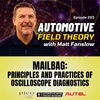
Mailbag: Principles and Practices of Oscilloscope Diagnostics [E255]
Watch Full Video EpisodeOscilloscopes are becoming more powerful, accessible, and common in repair shops—but choosing the right scope is only part of the equation. You also need to understand how your particular scope captures, stores, and displays its data.Matt Fanslow answers listener questions about automotive oscilloscopes, including the new eight-channel PicoScope, how many channels a shop actually needs, and whether beginners should start with an inexpensive scope or jump directly into a more capable platform.He also explains the distinctly different way Snap-on scopes handle their sample buffer, and why misunderstanding that behavior can cause a technician to lose the exact event they were trying to capture.Topics discussed include:What we currently know about Pico’s new eight-channel automotive scopeHow Pico BNC+ powers and automatically identifies compatible probes and transducersWhy current probes, pressure sensors, and microphones are all transducersWhere a single-channel AESwave uScope remains extremely usefulWhy two channels are helpful but a four-channel scope should now be considered a shop necessityWhen five, six, or eight channels become valuableUsing crankshaft, camshaft, ignition, and other signals togetherWhy the Snap-on Vantage Pro remains an excellent and affordable starting pointWhether a PicoScope is really too advanced for a first-time scope userHow modern scope hardware can compensate for less-than-perfect setup choicesWhy capable modern scopes resemble modern supercars: approachable in ordinary use, with substantial performance available when neededWhy oscilloscopes of this caliber should generally be considered shop equipmentHow Snap-on scope screens differ from the displays used by many other scopesUnderstanding the Snap-on screen as a window into a continuously moving bufferWhy Snap-on scopes allow technicians to zoom out after a capture—but not zoom inSetting the time base correctly when looking for details such as injector pintle movementHow a captured event can disappear from the buffer even though the display appears frozenWhen to save a screenshot instead of relying only on the scope-data fileThe difference between Snap-on’s Graphing Meter and Lab Scope modesCommon setup mistakes made by Snap-on scope usersThe practical limitations of older Snap-on sample rates and memory configurationsHow descriptive filenames make saved waveforms far easier to find years laterWhat vehicle, engine, system, signal, and operating-condition information should accompany a saved waveform?A scope is only useful when its operator understands what it is doing. Regardless of the brand, spend time learning how your instrument acquires, stores, displays, and saves information before an intermittent failure puts that knowledge to the test.Thanks to our Partners, Pico Technology and AutelAre you chasing elusive automotive problems? Pico Technology empowers you to see what's really happening. Their PicoScope oscilloscopes transform your diagnostic capabilities. PicoAuto.comFrom drivability diagnostics and TPMS service to ADAS and advanced safety systems, Autel helps technicians follow OEM procedures and repair with confidence. Autel.comContact InformationEmail Matt: mattfanslowpodcast@gmail.comSubscribe on YouTube: @automotivefieldtheoryThe Automotive Repair Podcast Network: https://automotiverepairpodcastnetwork.com/Download and Listen on Our Mobile App: https://automotiverepairpodcastnetwork.com/app/Remarkable Results Radio Podcast with Carm Capriotto: https://remarkableresults.biz/Business by the Numbers with Hunt Demarest: <a
Podzilla Summary coming soon
Sign up to get notified when the full AI-powered summary is ready.
Free forever for up to 3 podcasts. No credit card required.
Listen to This Episode
More from Automotive Field Theory
Cultivating Mechanical Aptitude in the AI Age [E256]
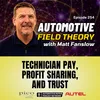
Technician Pay, Profit Sharing, and Trust [E254]

How to Start a Career in Auto Repair [E253]
It’s Never Too Late to Do the Right Thing: Lessons from YouTube, Jelly Roll and Physics [E252]
Get summaries like this every morning.
Free AI-powered recaps of Automotive Field Theory and your other favorite podcasts, delivered to your inbox.
Free forever for up to 3 podcasts. No credit card required.