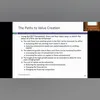
In this class, we started by drawing a contrast between price and value enhancement. With value enhancement, we broke down value change into its component parts: changing cash flows from existing assets, changing growth rates by either reinvesting more or better, lengthening your growth period by creating or augmenting competitive advantages and lowering your cost of capital. We then used this framework to compute an expected value of control as a the product of the probability of changing the way a company is run and the value increase from that change (optimal - status quo value). This expected value of control allows us to explain why market prices for stocks rise when corporate governance improves, why voting shares usually trade at a premium over non-voting shares (and why they sometimes don’t).Slides: https://www.stern.nyu.edu/~adamodar/podcasts/valUGspr22/session27slides.pdfPost class test: https://www.stern.nyu.edu/~adamodar/pdfiles/eqnotes/postclass/session27Atest.pdfPost class test solution: https://www.stern.nyu.edu/~adamodar/pdfiles/eqnotes/postclass/session27Asoln.pdf Learn more about your ad choices. Visit megaphone.fm/adchoices
Podzilla Summary coming soon
Sign up to get notified when the full AI-powered summary is ready.
Free forever for up to 3 podcasts. No credit card required.
Listen to This Episode
More from Aswath Damodaran

The Scaling and Profitability Trade-off: Venture Capital's weakest link!
From Eyeballs to ARR: Buzzy Pricing Metrics and the AI Trade!
The Prospectus is here: My (but not the) Anthropic IPO Valuation!
Heeding the Feedback Loop: A follow-up to my Anthropic Valuation
Get summaries like this every morning.
Free AI-powered recaps of Aswath Damodaran and your other favorite podcasts, delivered to your inbox.
Free forever for up to 3 podcasts. No credit card required.