Free Daily Podcast Summary
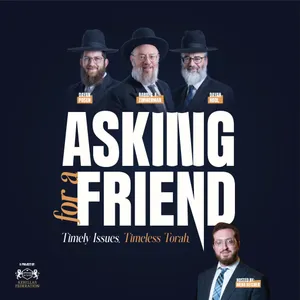
Asking For A Friend - Timely Issues. Timeless Torah.: Daily Summaries Delivered
by Kehillas Federation
Asking For A Friend is a podcast where real life dilemmas meet clear, thoughtful Torah perspective.Hosted by Mena Reisner, each episode features conversations with Rabbi Zimmerman, Dayan Hool, or Dayan Posen, Rabbonim with decades of experience in mediation, dinei Torah, shidduchim, family dynamics, business disputes, and the complex situations people face every day.It’s not personal psak and it’s not a shiur.Just honest, grounded discussion on the issues people grapple with behind closed doors, and how timeless Torah principles guide us through them.New episodes every two weeks.Questions or suggestions: podcast@federation.org.uk.
Latest Episodes
The most recent episodes — sign up to get AI-powered summaries of each one.
- Yesterday1h 17m
#23: His Money, Her Money: Who Really Owns What? - With Dayan Posen
Does a wife's salary really belong to her? How much is a husband obligated to provide for his wife? And what happens when one spouse is a spender and the other is a saver? In this fascinating episode of Asking For A Friend, Mena Reisner is joined by Dayan Yehoshua Posen to explore the financial rights and responsibilities of husbands and wives according to Halacha. From salaries, spending and inheritance to property ownership, divorce settlements, Kesubos and wills, they tackle some of the most sensitive and misunderstood aspects of money in marriage. Who owns money gifted by parents? What is a wife entitled to if a marriage ends? And how can she protect her financial future? An eye-opening discussion that challenges common assumptions and sheds light on what Halacha really says about money and marriage. This episode is kindly sponsored in honour of Meir Fine's birthday. Have a question for our upcoming Q&A with Rabbi Zimmerman? Email podcast@federation.org.uk. Subscribe and share Asking For A Friend with family and friends. Timestamps: 00:00 – Introduction 01:25 – The Husband’s Financial Obligations According to Halacha 04:10 – Who Owns a Wife’s Earnings? 11:35 – When the Wife Is the Primary Breadwinner 15:55 – A Wife’s Financial Independence and Spending Money 22:35 – Necessities vs. Luxuries in Marriage 28:55 – When One Spouse Is a Spender and the Other a Saver 31:00 – Making Major Purchases Without Spousal Consent 32:10 – Charitable Donations and Spousal Consent 36:35 – Debt and Financial Liability Between Spouses 43:25 – Can a Husband Require His Wife to Work? 48:20 – Inheritance and a Wife’s Personal Assets 54:25 – Jewelry and Gifts After Divorce 60:30 – Joint Property Ownership Under Halacha 63:55 – A Wife’s Rights to Her Husband’s Business 66:50 – Divorce, Asset Division, and Financial Security 67:35 – Protecting a Wife’s Financial Future 72:15 – Prenuptial Agreements and Halacha 73:55 – Wills, Inheritance, and Second Marriages 75:15 – Final Thoughts: Financial Responsibilities and Shalom Bayis
- 2 weeks ago1h 16m
#22: Segulos: What's Real and What's Not? - With Dayan Hool
Do segulos really work? Can they guarantee a yeshuah? And how do we distinguish a genuine segulah from superstition? From red strings and chai rotel to 40-day practices, visiting kivrei tzaddikim and paying others to daven on our behalf, segulos have become a familiar part of Jewish life. But where do these practices come from, what is their basis in Torah and Halachah, and how are they actually supposed to work? In this fascinating and thought-provoking episode, Dayan Hool explores the origins, legitimacy and misconceptions surrounding segulos, including some surprising distinctions between accepted Jewish practices and forbidden superstitions. And perhaps the biggest question of all: Are segulos a meaningful part of Yiddishkeit, or have we become so focused on finding shortcuts to a yeshuah that we're missing the point? Timestamps: 00:00 Introduction: What are segulos? 01:55 Defining segulos and distinguishing them from superstition 05:24 How mitzvos can bring specific rewards 09:02 Longevity and consistency in mitzvos 13:02 Rosh Hashanah simanim and symbolic foods 20:08 Kabbalah, false mystics, and exaggerated promises 28:04 Distinguishing healing practices from superstition 34:17 Red threads and their sources 37:37 Tehillim for someone who is ill 42:43 Paying others to daven and the role of tzedakah 47:50 The significance of forty days and a Kotel story 52:34 Rabbi Meir Baal Haness and lost objects 55:40 Providing food and drink as a segula 58:58 Segulos surrounding fertility and childbirth 01:04:04 Sandek and bris-related customs 01:04:28 Why a segula does not guarantee results 01:08:42 Prioritizing mitzvos and practical responsibilities 01:14:43 Final advice: how to evaluate a segula
- 4 weeks ago1h 26m
#21: Kosher: What Really Happens Behind the Scenes? - With Rabbi Y.M Guttentag
We see a hechsher on a product and rarely stop to think about what it actually took to put it there. In this episode, Mena Reisner is joined by Rabbi Yisroel Moshe Guttentag, Director of Certification and FedTech at KF Kosher, to go behind the scenes of modern kashrus. What does a mashgiach really look for when walking through a factory? How do you certify products being manufactured across multiple countries, using complex ingredients, shared machinery and global supply chains? And why can foods that appear completely straightforward turn out to be anything but? Rabbi Guttentag takes us inside the world of industrial kashrus — from ingredients and production equipment to factory inspections, dedicated machinery and the surprising problems that can emerge along the way. He explains how the level of supervision is determined, what goes into certifying major international food manufacturers, and why understanding how our food is actually made is so important. We also explore the crucial distinction between a product that is “Certified” and one that is simply “Approved” — and what consumers should understand when relying on either. A fascinating look at the extraordinary amount of work happening behind the scenes of something we encounter every single day: kosher food. Timestamps: 00:00 – Introduction 02:07 – Today’s topic: What really happens behind a hechsher 03:52 – What does a kosher certification actually certify? 14:08 – Which foods really need a hechsher? 16:43 – Gummy sweets, gelatin and dedicated kosher equipment 25:52 – Steam systems and hidden cross-contamination 33:11 – International ingredients and cooperation between kosher agencies 44:29 – Chewing gum, gum base and factory codes 49:21 – Multinational kosher certification 55:55 – Why canned tuna can require supervision 63:14 – Fruit juice, grape juice and shared pasteurizing equipment 71:26 – Certified vs. approved kosher products 77:09 – When approved kosher lists may be relied upon 81:24 – Ice pops and choosing certified products 85:10 – Closing thoughts on modern kashrus
- Sep 6, 202657 min
#20: Elul II - Rosh Hashanah & Yom Kippur - What Should We Actually Be Thinking About? - With Rabbi Zimmerman
We know what we do on Rosh Hashanah and Yom Kippur. But what are we actually supposed to be thinking and feeling? In the second part of this special Elul series, Mena Reisner continues his conversation with Rabbi S. F. Zimmerman, exploring the meaning behind the Yamim Noraim. Why do we celebrate on the Day of Judgment? Why is there almost no mention of teshuvah in the Rosh Hashanah tefillos? What is the shofar actually meant to achieve? What changes during Aseres Yemei Teshuvah, and what makes Yom Kippur fundamentally different from every other day? From Rosh Hashanah through Ne’ilah, a thought-provoking conversation about how to approach the most important days of the Jewish year and what we should actually be trying to achieve. Timestamps: [00:00] – Introduction; Elul Part 2 and Rosh Hashanah focus [00:39] – Rosh Hashanah as Yom HaDin and Yom Tov; fear vs simcha [05:23] – No vidui/confession in Rosh Hashanah davening [09:08] – Being “Mamluch Hashem” and defining essence as avdei Hashem [09:40] – Personal requests on Rosh Hashanah and “Hashem’s payroll” [13:06] – What shofar accomplishes; wake-up call and the Satan [18:13] – How shofar “confuses” the Satan; teshuva me’ahavah [19:32] – Why no shofar when Rosh Hashanah is on Shabbos [23:24] – Zechroinos/Yom Hazikaron – what Hashem is “remembering” [27:05] – From Rosh Hashanah to Aseres Yemei Teshuva [28:20] – What’s unique about Aseres Yemei Teshuva and beinonim [31:07] – What makes Yom Kippur so holy (kedusha) [34:06] – How Yom Kippur teshuva differs from year-round teshuva [37:18] – Bein adam lechaveiro: mechilah before Yom Kippur [42:26] – “I’m mochel everyone” – how that works [42:48] – Kol Nidrei and the power of speech [46:41] – Ne’ilah: final opportunity and special status [51:38] – After Yom Kippur: confidence and simcha [54:28] – Final message: “Ashreichem Yisrael” and closing
- Aug 23, 202653 min
#19: Elul I - Why Do We Keep Making the Same Mistakes? - With Rabbi Zimmerman
Every Elul, we promise ourselves that this year will be different. We’ll change, improve and leave old habits behind. So why do we so often find ourselves back in exactly the same place? In the first of this special Elul series, Mena Reisner sits down with Rabbi S. F. Zimmerman to explore what Elul and teshuvah are actually asking of us. Is Elul meant to be a time of fear or closeness? What does genuine teshuvah look like? Why is lasting change so difficult? And if we keep repeating the same mistakes year after year, does that mean our previous teshuvah failed? A practical and thought-provoking conversation about growth, failure and what Hashem really expects from us as we approach the Yamim Noraim. Elul opportunity: Join Vayidom’s 5-minutes-a-day Shmiras Halashon cycle and submit a name for Rabbi Zimmerman’s special tefillah at the Chofetz Chaim’s kever on his yahrzeit www.vayidom.com Time stamps: [00:00:00] – Intro & Elul Questions [00:01:55] – Elul: Melech Basadeh or Din? [00:06:40] – Elul as 30-Day Court Summons [00:12:10] – Avodah of Elul: Honest Self-Investigation [00:17:07] – Getting “Busy” in Ruchniyus: Help or Distraction? [00:21:36] – What Teshuva Really Is (Return vs Repentance) [00:26:57] – Teshuva Me’Ahava, Me’Yirah & How It Changes Sins [00:29:19] – Why We Repeat the Same Sins Every Year [00:36:36] – Is Repeated Teshuva Still Accepted? [00:45:00] – Jewish Teshuva & Turning in the Right Direction
- Jul 12, 20261h 19m
#18: Why Don't I Feel the Churban? - with Rabbi Zimmerman
As the Three Weeks give way to the Nine Days and Tisha B'Av, Jewish life changes dramatically. The music stops, celebrations become more restrained, and we begin mourning the destruction of the Beis Hamikdash. But what are we actually meant to be feeling? Why should we mourn something that happened nearly 2,000 years ago? What was truly lost, and what is the avodah of these weeks? In this episode, Rabbi Zimmerman explores the meaning behind the Three Weeks, the real definition of sinas chinam, what it means to believe in the Geulah, how to approach Tisha B'Av, and how each of us can play a part in bringing the rebuilding of the Beis Hamikdash closer. A timely and practical conversation to help transform the Three Weeks from a period we simply observe into one we genuinely understand. Timestamps: [0:01:46]–[0:06:31] – Three Weeks as opportunity, not just restriction [0:04:40]–[0:06:31] – Halacha as a “license” to mourn and yearn for Yerushalayim [0:06:31]–[0:09:11] – Avodah when you don’t “feel” the Churban [0:09:20]–[0:11:18] – Halachic framework of aveilus enabling everyone to mourn [0:11:28]–[0:14:27] – Churban as current reality, not only history [0:14:27]–[0:20:54] – What sinas chinam really is and how to work on it [0:23:18]–[0:28:05] – Torah: beyond “how-to” — valuing Torah itself [0:28:05]–[0:35:42] – Growing necessity and role of tefillah today [0:35:42]–[0:43:43] – Belief in and daily anticipation of Geulah/Moshiach [0:43:43]–[0:50:35] – How our broken generation can still bring Geulah [0:51:00]–[0:53:46] – Purpose of the Tisha B’Av fast: teshuvah like Yom Kippur [0:53:54]–[1:00:47] – Using kinnot and modern tragedies to understand and repair [1:00:47]–[1:02:13] – Personal bakashos and their root in geulah consciousness [1:02:33]–[1:07:24] – How to approach Tisha B’Av day; the Kaddish mashal [1:08:00]–[1:11:45] – Building ahavas Yisrael by expanding the self [1:11:45]–[1:16:12] – Shabbos Nachamu and the nature of nechama [1:16:50]–[1:18:39] – Final message: mourning as immediate kirvas Hashem
- Jul 5, 20261h 13m
#17: "You Can Win in Business and Still Lose in Halacha" - with Dayan Posen
Can you leave your job and take your clients with you? If you transform your father's business, who really owns that success? When does healthy competition cross the line, and can schools or businesses actively poach staff? In this episode of Asking for a Friend, Dayan Posen explores some of the most practical and misunderstood areas of Choshen Mishpat. From employees and employers to family businesses, partnerships and competition, we examine where halacha draws the line between legitimate business practice and unfair conduct. Whether you're an employee, employer, business owner or simply interested in Torah's approach to business ethics, this episode offers practical guidance on navigating the workplace with integrity, fairness and emunah. Timestamps: **00:00–02:10** – Intro to the podcast, new Cheish Mishpat series, and definitions of *oni ha‑mehapech* & *hasagas gevul*. **02:38–03:47** – Core scenario: Reuven the long‑term employee vs Shimon the employer; ultimatum of partnership or leaving with clients. **05:58–08:10** – Employee’s mindset: “I built this; I want to own something for my family.” **08:10–10:46** – “Partner in profits” explained as **commission, not real ownership**; crop‑share analogy. **10:46–13:22** – Pros and cons of profit‑share: good incentive but no true security or equity. **13:22–16:54** – Leaving and taking clients: contracts, non‑compete/non‑solicit; whose clients are they? **16:54–22:22** – Source and nature of *oni ha‑mehapech* in Chazal; being called a *rasha*; public “naming and shaming” in theory. **23:47–29:08** – Practical application: approaching former employer’s clients, direct vs indirect; general advertising vs targeted contact. **29:08–32:36** – WhatsApp status, circulars, email farewell messages – what’s allowed, what’s too direct. **32:36–35:12** – Employers’ fear of training someone who later “takes the business”; possibility of halachic contracts. **35:12–42:08** – Poaching rabbeim/teachers; *metziah* concept; Ashkenazi vs Sefardi angles; *ba’al nefesh yachmir*. **42:08–48:02** – Fisherman/net story; when competition crosses into destroying someone’s parnassa. **48:02–56:22** – *Hasagas gevul* today: normal competition vs wiping out a niche business; monopolies and community benefit. **57:25–01:04:52** – Family business case: child grows parents’ business, ownership, siblings, and inheritance tensions. **01:04:52–01:09:07** – Children asking parents about expectations; importance of written clarity in family businesses. **01:09:07–01:13:19** – Closing hashkafa: *nasata v’nasata be’emunah*, link to learning the halachos, business as a daily arena for emunah.
- Jun 23, 202611 min
#16: Electric Scooters: "In My Opinion, It's Absolutely Ossur" - with Rabbi Zimmerman
Electric scooters have become a familiar sight in many communities. For some, they're a convenient way to get to school, shiurim, friends' houses and local activities. For others, they're a growing source of concern. In this special mini episode, Rabbi S F Zimmerman addresses one of the most discussed topics affecting children, teenagers and parents today. Are electric scooters simply a modern convenience, or is there a deeper issue at stake? How should parents respond when "everyone in the class has one"? Who bears responsibility – parents, schools, rabbonim, or the wider community? And what should a family do if a child has already spent hundreds of pounds of Bar Mitzvah money on a scooter? A concise but important discussion offering Daas Torah and practical guidance on a topic generating debate across the UK, the USA and beyond. Sponsored anonymously by someone who believes this episode could save lives.
Get Asking For A Friend - Timely Issues. Timeless Torah. summaries in your inbox
Free AI-powered daily recaps. Key takeaways, quotes, and mentions — in a 5-minute read.
Get Free Summaries →Free forever for up to 3 podcasts. No credit card required.
You Might Also Like
Listeners also like.

Ask Haviv Anything
A history podcast shaped by listener questions, covering identity, conflict, and culture with moments of humor.

The Jewish History Podcast - With Rabbi Yaakov Wolbe
A podcast featuring Rabbi Yaakov Wolbe's lectures on Jewish history.

On the Other Hand: Ten Minutes of Torah
ReformJudaism.org

Jewish Stories to Inspire: Motivational & Spiritual Stories Based on the Torah's Ethics, Values and Wisdom
Inspirational Jewish stories drawn from the Torah, sages, and chassidic tradition that convey spiritual and ethical lessons.

Into the Verse - A Parsha Podcast
Aleph Beta

Talk2Tamara
Tamara Gestetner

Tablet Studios
Explores Jewish identity, tradition, and culture through diverse podcasts offering insight for contemporary Jewish life.

Da Mah Shetashiv
Rabbi Aaron Lopiansky

Let's Talk Tanya
Chabad.org: Naftali Silberberg

Judaism's Top Talks
National Jewish Retreat

Oversharing
Sisters Jordana Abraham and Dr. Naomi Bernstein discuss relationship challenges, answering listener questions with humor and therapy insights.

EconTalk
Long-form conversations on economics, philosophy, history, and human behavior with experts from diverse fields.
About Asking For A Friend - Timely Issues. Timeless Torah.
Asking For A Friend is a podcast where real life dilemmas meet clear, thoughtful Torah perspective.Hosted by Mena Reisner, each episode features conversations with Rabbi Zimmerman, Dayan Hool, or Dayan Posen, Rabbonim with decades of experience in mediation, dinei Torah, shidduchim, family dynamics, business disputes, and the complex situations people face every day.It’s not personal psak and it’s not a shiur.Just honest, grounded discussion on the issues people grapple with behind closed doors, and how timeless Torah principles guide us through them.New episodes every two weeks.Questions or suggestions: podcast@federation.org.uk.
Customized Recaps
AI-powered recaps with compact key takeaways, quotes, and insights.
Straight to Your Inbox
Get key takeaways from Asking For A Friend - Timely Issues. Timeless Torah. in a 5-minute read.
Save Hours Every Week
Stay current on your favorite podcasts without falling behind.
Frequently Asked Questions
What is Podzilla's Asking For A Friend - Timely Issues. Timeless Torah. daily summary?
It's a free AI-powered email that summarizes new episodes of Asking For A Friend - Timely Issues. Timeless Torah. as soon as they're published. You get the key takeaways, notable quotes, and links & mentions — all in a quick read.
How does the Asking For A Friend - Timely Issues. Timeless Torah. podcast summary work?
When a new episode drops, our AI transcribes and analyzes it, then generates a personalized summary tailored to your interests and profession. It's delivered to your inbox every morning.
Is this an official Asking For A Friend - Timely Issues. Timeless Torah. product?
No. Podzilla is an independent service that summarizes publicly available podcast content. We're not affiliated with or endorsed by Kehillas Federation.
Can I get summaries of other podcasts too?
Absolutely! The free plan covers up to 3 podcasts, any in the catalog. Basic raises that to 15, Pro to 40 and Max to 100. Browse our full catalog at /podcasts.
How often does Asking For A Friend - Timely Issues. Timeless Torah. release new episodes?
Asking For A Friend - Timely Issues. Timeless Torah. publishes biweekly. Our AI generates a summary within hours of each new episode.
What topics does Asking For A Friend - Timely Issues. Timeless Torah. cover?
Asking For A Friend - Timely Issues. Timeless Torah. covers topics including Education, Religion & Spirituality, Spirituality, Judaism. Our AI identifies the specific themes in each episode and highlights what matters most to you.
Start getting Asking For A Friend - Timely Issues. Timeless Torah. summaries tomorrow morning.
Free forever for up to 3 podcasts. No credit card required.
Free forever for up to 3 podcasts. No credit card required.