Free Daily Podcast Summary
APA Religions 101: Daily Summaries Delivered
by Axis Mundi Media + APARRI
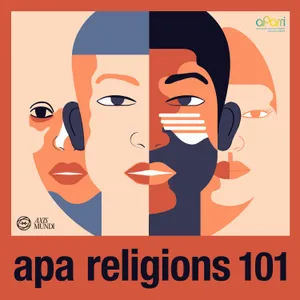
An introduction to Asian and Pacific American religions through interviews with experts and practitioners, host Dr. Bradley Onishi speaks with APA scholars about:* Asian American Catholicism* Asian American Buddhism before and beyond Whiteness* Fighting racism with the wisdom of Sikh teachings* Doing Muslim theology as a Vietnamese American* Asian American evangelicals in the MAGA Age* The challenges of creating Filipino religious communities* Race, Jim Crow, and the origins of modern yoga* Caste privilege in the United States and India* Asian Americans and Affirmative Action* Racialized Capitalism* Being Jewish, Japanese, queer and clergyThis series is a joint venture between APARRI and Axis Mundi Media. The series producer is Dr. Bradley Onishi: @bradleyonishi and the audio engineer and musician is Scott Okamoto: @rsokamoto. For more information about research-based media by Axis Mundi Media visit: www.axismundi.us ( https://www.axismundi.us/ ). Funding for this series ha
Latest Episodes
The most recent episodes — sign up to get AI-powered summaries of each one.
- Jun 10, 202433 min
Japanese, Jewish, Queer, and Clergy with Rev. Laura Cheifetz
Japanese, Jewish, Queer, and Clergy with Rev. Laura Cheifetz Bradley Onishi interviews Reverend Laura Mariko Chaffetz, discussing her experiences as a multiracial queer Asian American Christian minister with Jewish heritage. They examine how APA religious communities navigate the black-white binary in the U.S., the impact of anti-Asian racism during the pandemic, and the dynamics of Christian identity in various contexts. The conversation highlights the importance of recognizing and valuing the diverse and rich religious practices among Asian Pacific Americans.Laura Cheifetz is the co-author and editor of "Church on Purpose: Reinventing Discipleship, Community, & Justice" (Judson Press) and contributor to "Race in a Post Obama America: The Church Responds" (Westminster John Knox Press), "Leading Wisdom: Asian and Asian North American Women Leaders" (WJK), "Here I Am: Faith Stories of Korean American Clergywomen" (Judson), and "Streams Run Uphill: Conversations with Young Clergywomen of Color" (Judson). She is co-author of the "Forming Asian Leaders for North American Churches" entry in the "Religious Leadership" reference handbook (SAGE Publishing).Learn more about APARRI. APARRI’s vision is to create a society in which Asian Pacific American religions are valued, recognized, and central to the understanding of American public life. Since 1999, The Asian Pacific American Religions Research Initiative (APARRI) has been a vibrant scholarly community advancing the interdisciplinary study of Asian Pacific Americans and their religions. Producer: Dr. Bradley Onishi: @bradleyonishiAudio Engineer and Musician: Scott Okamoto: @rsokamotoFor more information about research-based media by Axis Mundi Media visit: www.axismundi.usFunding for this series has been generously provided by the Henry Luce Foundation.
- Jun 10, 202438 min
Caste Privilege in the United States and India with Dr. Himanee Gupta
Brad speaks with Dr. Himanee Gupta, Professor in the Department of Historical Studies at SUNY Empire State and the author of "Muncie, India(na): Middletown and Asian America," about howt South Asians in the United States who grew up in the Hindu faith are caste-privileged or savarna (which means having varna, a term often equated to having spiritual purity). By contrast, Dalits like Soundararajan are avarna (without varna) and thereby deemed within this system as impure. These categorizations have found legitimacy through the promulgation of a Brahmanical form of Hinduism that shares affinities with the conservative pro-Hindu politics of India’s current leadership. Learn more about APARRI. APARRI’s vision is to create a society in which Asian Pacific American religions are valued, recognized, and central to the understanding of American public life. Since 1999, The Asian Pacific American Religions Research Initiative (APARRI) has been a vibrant scholarly community advancing the interdisciplinary study of Asian Pacific Americans and their religions. Producer: Dr. Bradley Onishi: @bradleyonishiAudio Engineer and Musician: Scott Okamoto: @rsokamotoFor more information about research-based media by Axis Mundi Media visit: www.axismundi.usFunding for this series has been generously provided by the Henry Luce Foundation.
- Jun 10, 202441 min
Beyond Whiteness: Conservatism and Fascism in Asian American Evangelical and Catholic Communities with Drs. Jane Hong and Adrian De Leon
Many wonder how and why religious minorities in the USA adopt conservative – and even fascist – political identities when it seems that the American Right is anti-immigrant and in many cases explicitly racist. Scholars Dr. Jane Hong (Occidental) and Dr. Adrian de Leon (USC/NYU) argue that Asian American (religious) conservatism should be understood not just as an imported phenomenon from outside these communities, but as something structural within the formation of Asian America itself.Special Issue of Amerasia: https://www.tandfonline.com/doi/full/10.1080/00447471.2023.2167934Dr. Jane Hong is the author of Opening the Gates to Asia: A Transpacific History of How America Repealed Asian Exclusion (University of North Carolina Press, 2019). She serves on the editorial board of the Journal of American History, the Gilder-Lehrman Scholarly Advisory Board, the managing board of the Asian Pacific American Religions Research Initiative (APARRI), and the Board of Directors of the Public Religion Research Institute(PRRI). Hong appears in two episodes of the Peabody Award-winning PBS docuseries, Asian Americans (2020). An active public speaker, Hong has shared her expertise with the Brookings Institution, Uber, and NPR’s The Takeaway, in addition to academic and faith-based venues. Dr. Adrian De Leon is an award-winning public historian and writer. Bundok: A Hinterland History of Filipino America, his first academic book, uses archival research in the Philippines, Hawai‘i, North America, and Spain in order to follow the co-constitution of Philippine indigeneity and Filipino migrant labor through the racial archives of 19th-century plantation capitalism in Luzon’s northern hinterlands.Learn more about APARRI. APARRI’s vision is to create a society in which Asian Pacific American religions are valued, recognized, and central to the understanding of American public life. Since 1999, The Asian Pacific American Religions Research Initiative (APARRI) has been a vibrant scholarly community advancing the interdisciplinary study of Asian Pacific Americans and their religions. Producer: Dr. Bradley Onishi: @bradleyonishiAudio Engineer and Musician: Scott Okamoto: @rsokamotoFor more information about research-based media by Axis Mundi Media visit: www.axismundi.usFunding for this series has been generously provided by the Henry Luce Foundation.
- Jun 10, 202432 min
Asian Americans and Affirmative Action with Dr. Janelle Wong
In June 2023, the SCOTUS ruled that race cannot be used in the college admissions process. Many in and outside of the Asian American community see the ruling as positive for Asian American students who are supposedly disadvantaged by affirmative action policies. Brad talks with Dr. Janelle Wong of the University of Maryland about what the data tells us concerning Asian American acceptance rates, how this ruling will affect BIPOC Americans on the whole, and the ways the model minority myth is used to divide and conquer people of color and Black Americans in the United States.Dr. Janelle Wong is Professor of American Studies at the University of Maryland. Prior to joining the University of Maryland in 2012, she was at the University of Southern California in the Departments of Political Science and American Studies and Ethnicity. Wong is author of Immigrants, Evangelicals and Politics in an Era of Demographic Change (2018, Russell Sage Foundation Press), Democracy’s Promise: Immigrants and American Civic Institutions (2006, University of Michigan Press) and co-author of two books on Asian American politics. The most recent is Asian American Political Participation: Emerging Constituents and their Political Identities (2011, Russell Sage Foundation), based on the first nationally representative survey of Asian Americans’ political attitudes and behavior. Learn more about APARRI. APARRI’s vision is to create a society in which Asian Pacific American religions are valued, recognized, and central to the understanding of American public life. Since 1999, The Asian Pacific American Religions Research Initiative (APARRI) has been a vibrant scholarly community advancing the interdisciplinary study of Asian Pacific Americans and their religions. Producer: Dr. Bradley Onishi: @bradleyonishiAudio Engineer and Musician: Scott Okamoto: @rsokamotoFor more information about research-based media by Axis Mundi Media visit: www.axismundi.usFunding for this series has been generously provided by the Henry Luce Foundation.
- Jun 4, 202438 min
Between Mother India and Jim Crow with Philip Deslippe
Brad speaks with journalist and scholar Philip Deslippe about the origins of yoga in the United States as a response to the precarity of South Asian lives in the 20th century America. "A century ago, students of yoga in the United States, like many practitioners today, believed that they were engaging in something pure, ancient, and Indian. In reality, the yoga they were doing was a bricolage of the metaphysical and mundane presented to them in an exotic, Orientalized package by largely educated and worldly immigrants from India. These teachers were themselves responding and adapting to a nativist and racist climate. Yoga in the United States during the interwar decades is one of many examples of how Asian religions in the United States cannot be fully understood outside the context of Asian American history."Learn more about APARRI. APARRI’s vision is to create a society in which Asian Pacific American religions are valued, recognized, and central to the understanding of American public life. Since 1999, The Asian Pacific American Religions Research Initiative (APARRI) has been a vibrant scholarly community advancing the interdisciplinary study of Asian Pacific Americans and their religions. Producer: Dr. Bradley Onishi: @bradleyonishiAudio Engineer and Musician: Scott Okamoto: @rsokamotoFor more information about research-based media by Axis Mundi Media visit: www.axismundi.usFunding for this series has been generously provided by the Henry Luce Foundation.
- Jun 3, 202432 min
Filipino Theology Between Asian America and the United States with Dr. Gabriel Catanus
Brad speaks with Dr. Gabriel Catanus, Affiliate Assistant Professor of Theology at Fuller Seminary and Director of the Filipino American Ministry Initiative, about the challenges and joys of doing Filipino American theology and ministry and how they fit - and stand out - from other Asian American theological and ministry paradigms.Beyond his current project with Cascade Books, Dr. Catanus' publications include “Colonial Spirituality: The Pain and Politics of Doing Filipino American Theology,” ChristianityNext 6 (Winter 2022), “Statement on Anti-Asian Racism in the Time of COVID-19″ (coauthored with the Asian American Christian Collaborative, March 31, 2020), and “Is Filipino American Theology Asian American Theology?” Inheritance Magazine 65 (October 2019).Learn more about APARRI. APARRI’s vision is to create a society in which Asian Pacific American religions are valued, recognized, and central to the understanding of American public life. Since 1999, The Asian Pacific American Religions Research Initiative (APARRI) has been a vibrant scholarly community advancing the interdisciplinary study of Asian Pacific Americans and their religions. Producer: Dr. Bradley Onishi: @bradleyonishiAudio Engineer and Musician: Scott Okamoto: @rsokamotoFor more information about research-based media by Axis Mundi Media visit: www.axismundi.usFunding for this series has been generously provided by the Henry Luce Foundation.
- Jun 3, 202429 min
Fighting Racism with the Wisdom of the Sikh Tradition with Dr. Simran Jeet Singh
Brad speaks with Dr. Simran Jeet Singh , Executive Director for the Aspen Institute’s Religion & Society Program and author of The Light We Give: How Sikh Wisdom Can Transform Your Life.As a boy growing up in South Texas, Simran Jeet Singh and his brothers confronted racism daily: at school, in their neighborhood, playing sports, and later in college and beyond. Despite the prejudice and hate he faced, this self-described “turban-wearing, brown-skinned, beard-loving Sikh” refused to give in to negativity. Instead, Singh delved deep into the Sikh teachings that he grew up with and embraced the lessons to seek the good in every person and situation and to find positive ways to direct his energy. These Sikh tenets of love and service to others have empowered him to forge a life of connection and a commitment to justice that have made him a national figure in the areas of equity, inclusion, and social justice.The Light We Give: https://simranjeetsingh.org/the-light-we-give/Learn more about APARRI. APARRI’s vision is to create a society in which Asian Pacific American religions are valued, recognized, and central to the understanding of American public life. Since 1999, The Asian Pacific American Religions Research Initiative (APARRI) has been a vibrant scholarly community advancing the interdisciplinary study of Asian Pacific Americans and their religions. Producer: Dr. Bradley Onishi: @bradleyonishiAudio Engineer and Musician: Scott Okamoto: @rsokamotoFor more information about research-based media by Axis Mundi Media visit: www.axismundi.usFunding for this series has been generously provided by the Henry Luce Foundation.
- Jun 3, 202429 min
A Vietnamese American Muslim Theologian at a Catholic Funeral with Dr. Martin Nguyen
Brad speaks with Dr. Martin Nguyen, who explains how his personal story impacts his understanding race, theology, culture, and heritage.As he explains, "t is difficult for me to imagine doing theology, then, without also considering who I am—my being Vietnamese, Asian, American, once Catholic, and now Muslim. Race and religion are entangled in the narrative of my life. They even shape my childhood memories as a son of Vietnamese Catholic refugees, born and raised in Virginia."Dr. Nguyen is a scholar of Muslim theology and Islamic studies. His scholarship revolves around ethics, constructive theology, Qur’anic studies, and the intersection of race and religion. His most recent book Modern Muslim Theology: Engaging God and the World with Faith and Imagination presents a contemporary theology rooted in the practice of the religious imagination. A professor of religious studies, he is presently chair of the department at Fairfield University in Connecticut.Learn more about APARRI. APARRI’s vision is to create a society in which Asian Pacific American religions are valued, recognized, and central to the understanding of American public life. Since 1999, The Asian Pacific American Religions Research Initiative (APARRI) has been a vibrant scholarly community advancing the interdisciplinary study of Asian Pacific Americans and their religions. Producer: Dr. Bradley Onishi: @bradleyonishiAudio Engineer and Musician: Scott Okamoto: @rsokamotoFor more information about research-based media by Axis Mundi Media visit: www.axismundi.usFunding for this series has been generously provided by the Henry Luce Foundation.
Get APA Religions 101 summaries in your inbox
Free AI-powered daily recaps. Key takeaways, quotes, and mentions — in a 5-minute read.
Get Free Summaries →Free forever for up to 3 podcasts. No credit card required.
You Might Also Like
Listeners also like.

Complexified
Explores how religion and politics intersect with everyday life to uncover hidden histories and envision paths for social change.

Scope Conditions Podcast
A podcast showcasing cutting-edge research in comparative politics.

The Alisa Childers Podcast
Addressing progressive Christianity and skeptical challenges to the gospel from a biblical perspective.

Pints With Aquinas
Discussions and teachings on the Catholic faith inspired by the works of Thomas Aquinas.

Inheriting
Examines how historical events affect Asian American and Pacific Islander families through intimate intergenerational conversations.

In Our Time: Religion
Explores religious movements, their theories, and key figures.

The Christian Outlook | Full Interviews
Salem Podcast Network

Faith Unraveled Podcast
Elisha Lee

Asia Specific
BBC World Service

We Don’t Always Agree with Ryan & Sterling
A Hollywood couple discusses evolving social issues and timeless debates with humor and depth, exploring how disagreement can foster growth.
Beyond Belief: Tales of Religious Exodus
Freidom Fighter

The Spirit Underground with Spring Washam and Lama Rod Owens
Be Here Now Network
About APA Religions 101
An introduction to Asian and Pacific American religions through interviews with experts and practitioners, host Dr. Bradley Onishi speaks with APA scholars about:* Asian American Catholicism* Asian American Buddhism before and beyond Whiteness* Fighting racism with the wisdom of Sikh teachings* Doing Muslim theology as a Vietnamese American* Asian American evangelicals in the MAGA Age* The challenges of creating Filipino religious communities* Race, Jim Crow, and the origins of modern yoga* Caste privilege in the United States and India* Asian Americans and Affirmative Action* Racialized Capitalism* Being Jewish, Japanese, queer and clergyThis series is a joint venture between APARRI and Axis Mundi Media. The series producer is Dr. Bradley Onishi: @bradleyonishi and the audio engineer and musician is Scott Okamoto: @rsokamoto. For more information about research-based media by Axis Mundi Media visit: www.axismundi.us ( https://www.axismundi.us/ ). Funding for this series ha
Customized Recaps
AI-powered recaps with compact key takeaways, quotes, and insights.
Straight to Your Inbox
Get key takeaways from APA Religions 101 in a 5-minute read.
Save Hours Every Week
Stay current on your favorite podcasts without falling behind.
Frequently Asked Questions
What is Podzilla's APA Religions 101 daily summary?
It's a free AI-powered email that summarizes new episodes of APA Religions 101 as soon as they're published. You get the key takeaways, notable quotes, and links & mentions — all in a quick read.
How does the APA Religions 101 podcast summary work?
When a new episode drops, our AI transcribes and analyzes it, then generates a personalized summary tailored to your interests and profession. It's delivered to your inbox every morning.
Is this an official APA Religions 101 product?
No. Podzilla is an independent service that summarizes publicly available podcast content. We're not affiliated with or endorsed by Axis Mundi Media + APARRI.
Can I get summaries of other podcasts too?
Absolutely! The free plan covers up to 3 podcasts, any in the catalog. Basic raises that to 15, Pro to 40 and Max to 100. Browse our full catalog at /podcasts.
How often does APA Religions 101 release new episodes?
APA Religions 101 publishes daily. Our AI generates a summary within hours of each new episode.
What topics does APA Religions 101 cover?
APA Religions 101 covers topics including Arts, Books, Religion & Spirituality, Spirituality. Our AI identifies the specific themes in each episode and highlights what matters most to you.
Start getting APA Religions 101 summaries tomorrow morning.
Free forever for up to 3 podcasts. No credit card required.
Free forever for up to 3 podcasts. No credit card required.