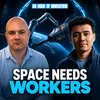
The Space Economy Has a Labor Problem | Ethan Barajas
The future of the space economy may depend less on rockets and more on solving the space robotics labor problem.In this episode of An Hour of Innovation podcast, Vit Lyoshin speaks with Ethan Barajas, co-founder and CEO of Icarus Robotics, about why commercial space stations, orbital infrastructure, and space manufacturing cannot scale if astronauts are doing routine operational work. They explore how space robots, AI robotics, and autonomous systems could help move cargo, maintain equipment, support experiments, and create the labor layer needed for a real space economy.They discussed:* Why the space economy has a labor problem* How astronauts spend time on routine station work* Why rockets do not solve orbital operations* How space robotics can support commercial stations* Why AI robotics is harder in microgravity* How Icarus Robotics plans its ISS demonstration* What founders learn building for emerging markets* Why robot workers may unlock orbital manufacturing* How teleoperation can train autonomous space robots* What commercial space needs after cheaper launchesEthan Barajas is the co-founder and CEO of Icarus Robotics, a startup building robotic workers for space stations and orbital infrastructure. He is known for focusing on one of the least glamorous but most important problems in space: human labor does not scale in orbit. His company is developing robots that can assist astronauts with cargo movement, maintenance, experiment setup, and routine station operations. Ethan brings a practical founder’s perspective on space robotics, AI autonomy, and building for a market that is still forming but could become essential to the future space economy.Timestamps00:00 Introduction00:57 The Future of Labor in Space05:15 Understanding the Costs of Human Spaceflight07:29 The Role of Robots in Space Operations11:43 Innovations in Space Robotics13:46 Testing and Development of Space Robots18:34 The Integration of AI in Space Robotics24:33 Service Model for Space Robotics25:56 Understanding Market Needs31:38 Roadmap and Product Development35:18 Trade-offs in Functionality37:57 The Role of Humans in Space41:00 Envisioning Future Space Operations43:53 Innovation Q&AConnect with Ethan* Website: https://www.icarusrobotics.com/ * LinkedIn: https://www.linkedin.com/in/ethan-barajas/ Support the PodcastIf you enjoy the podcast, you can support it by exploring the tools below.These are affiliate links, meaning the show earns a small commission at no extra cost to you.Kit: Email marketing that automates your growth. https://partners.kit.com/xqcc7ca2ahlmAmplemarket: Step into the future of sales: Human + AI. Empower reps, uncover opportunities, and grow revenue.https://grow.amplemarket.com/04e068165684-affiliateDatabox: Turn business performance data into clear answers your team can understand, explain, and act on – instantly.https://join.databox.com/vhw0wbr9qg9o For inquiries about sponsoring An Hour of Innovation, email iris@anhourofinnovation.comConnect with Vit* Substack: https://anhourofinnovation.substack.com/* LinkedIn: https://www.linkedin.com/in/vit-lyoshin/ * X: https://x.com/vitlyoshin
Podzilla Summary coming soon
Sign up to get notified when the full AI-powered summary is ready.
Free forever for up to 3 podcasts. No credit card required.
Listen to This Episode
More from An Hour of Innovation: AI, Product, Tech and Career Growth

The Real Product-Market Fit Problem Is Emotional | Ravi Sawhney

AI’s Biggest Bottleneck Isn’t GPUs — It’s Power | Sergii Gerasymovych

The Quantum Threat to Encryption Is Already Here | Dr. Shohini Ghose

Why Products Win When They Stop Serving Everyone | Krystian Kolondra (SVP at Opera)
Get summaries like this every morning.
Free AI-powered recaps of An Hour of Innovation: AI, Product, Tech and Career Growth and your other favorite podcasts, delivered to your inbox.
Free forever for up to 3 podcasts. No credit card required.