Free Daily Podcast Summary
All the Best — UNL Chemistry Faculty Tell Their Stories: Daily Summaries Delivered
by Mark Griep
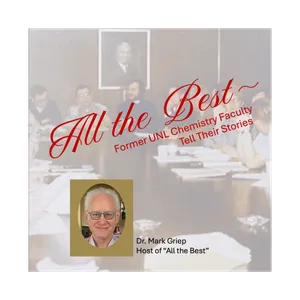
Welcome to All the Best UNL Chemistry Faculty Tell Their Stories, an interview series with retired and former faculty from the Chemistry Department at the University of Nebraska-Lincoln. For undergraduate and graduate students, listening to these stories will help you understand what motivates the professors who are teaching your courses and how to find a research position in their labs. For potential faculty, listening to these stories can help you understand the power structure of a department including how to obtain access to specialized instrumentation and how teaching assignments are made. For the broader public, these stories provide a perspective on one small corner of our vastly interesting world. Since retired and former faculty have experiences that reach back more than half a century, the series will provide a personal view how the department’s history evolved.
Latest Episodes
The most recent episodes — sign up to get AI-powered summaries of each one.
- May 20, 202644 min
James Carr, Iron Oxidation Analysis; Freshman Program Coordinator; interviewed by Tice Miller in 2011
This oral history is part of the University of Nebraska-Lincoln Emeriti Association Oral Historieshttps://mediacommons.unl.edu/luna/servlet/detail/UNL~86~86~135~1448694?qvq=lc:UNL~86~86&mi=19&trs=48
- May 16, 20261h 48m
Robert Powers, NMR-Assisted Drug Discovery
Dr. Robert Powers became a chemistry professor at the University of Nebraska-Lincoln in 2003 and is about to retire after 23 years. Prior to UNL, Bob was a drug discovery researcher for 11 years at American Cyanamid, which eventually became Wyeth and is now part of Pfizer. Bob was born in Jersey, New Jersey. Something in his youth must have sparked an interest in chemistry because he earned a bachelor's in that subject from Rutgers University of New Brunswick, New Jersey. Then he traveled 1200 miles west to Purdue University in Indiana where he earned his doctorate. Next, he did postdoctoral research at the National Institutes of Health in the labs of Marius Clore & Angela Gronenborn. They were pioneers of using NMR to study biological macromolecules. At UNL, Bob’s lab has studied NMR-Assisted Drug Discovery.
- Apr 14, 20262h 4m
David Berkowitz, Enzyme-Assisted Organic Synthesis; NSF Officer
Dr. Dave Berkowitz was born in 1960 in Urbana, Illinois. He earned a bachelor’s degree in chemistry from the University of Chicago, where he did undergraduate research. Next, he earned his doctorate from Harvard University. However, his advisor, Steve Benner, moved from Harvard to ETH Zurich, also called the Swiss Federal Institute of Technology. Dave accompanied him to Zurich where he completed his dissertation work. When Dave returned to the US, he did a postdoc with the legendary Samuel Danishefsky at Yale University. In 1991, he joined UNL as an assistant professor of Chemistry and quickly rose through the ranks. Dave is now in his 35th year in the department.Let me mention three remarkable things about Dave before we start. One is that he served as chair of the department, except that his term was interrupted when he agreed to return to NSF after they had an unexpected opening in a leadership position (Chemistry Division Director) that they needed to fill quickly.. Another is that he co-established the Nebraska Drug Discovery and Development Pipeline (ND3P), a partnership between UNL and the University of Nebraska Medical Center. Finally, and most recently, he served as Assistant Director of the NSF Directorate for Mathematical and Physical Sciences.
- Feb 19, 20261h 14m
George Sturgeon, Metal Fluoride Compounds; Vice Chair
Dr. George Sturgeon was a chemistry professor at the University of Nebraska -Lincoln for 39 years, from 1964 to 2003. During his time at UNL, he spent 15 years as the vice chair. I like to say that multiple chairs served under him. George was born in Sioux Falls, South Dakota, but grew up in Jamestown, North Dakota. Something in his youth must have sparked an interest in chemistry because he earned a bachelor's in that subject from the University of North Dakota in Grand Forks. Then he traveled 870 miles east to Michigan State University in East Lansing where he earned his doctorate. Immediately after graduating, he joined the University of Nebraska-Lincoln in 1964 as an assistant professor but was soon promoted to associate professor. His lab studied metal fluoride compounds including xenon difluoride.
About All the Best — UNL Chemistry Faculty Tell Their Stories
Welcome to All the Best UNL Chemistry Faculty Tell Their Stories, an interview series with retired and former faculty from the Chemistry Department at the University of Nebraska-Lincoln. For undergraduate and graduate students, listening to these stories will help you understand what motivates the professors who are teaching your courses and how to find a research position in their labs. For potential faculty, listening to these stories can help you understand the power structure of a department including how to obtain access to specialized instrumentation and how teaching assignments are made. For the broader public, these stories provide a perspective on one small corner of our vastly interesting world. Since retired and former faculty have experiences that reach back more than half a century, the series will provide a personal view how the department’s history evolved.
Customized Recaps
AI-powered recaps with compact key takeaways, quotes, and insights.
Straight to Your Inbox
Get key takeaways from All the Best — UNL Chemistry Faculty Tell Their Stories in a 5-minute read.
Save Hours Every Week
Stay current on your favorite podcasts without falling behind.
Frequently Asked Questions
What is Podzilla's All the Best — UNL Chemistry Faculty Tell Their Stories daily summary?
It's a free AI-powered email that summarizes new episodes of All the Best — UNL Chemistry Faculty Tell Their Stories as soon as they're published. You get the key takeaways, notable quotes, and links & mentions — all in a quick read.
How does the All the Best — UNL Chemistry Faculty Tell Their Stories podcast summary work?
When a new episode drops, our AI transcribes and analyzes it, then generates a personalized summary tailored to your interests and profession. It's delivered to your inbox every morning.
Is this an official All the Best — UNL Chemistry Faculty Tell Their Stories product?
No. Podzilla is an independent service that summarizes publicly available podcast content. We're not affiliated with or endorsed by Mark Griep.
Can I get summaries of other podcasts too?
Absolutely! The free plan covers up to 3 podcasts. Upgrade to Pro for 15, or Premium for 50. Browse our full catalog at /podcasts.
How often does All the Best — UNL Chemistry Faculty Tell Their Stories release new episodes?
All the Best — UNL Chemistry Faculty Tell Their Stories publishes monthly. Our AI generates a summary within hours of each new episode.
What topics does All the Best — UNL Chemistry Faculty Tell Their Stories cover?
All the Best — UNL Chemistry Faculty Tell Their Stories covers topics including Science, Chemistry. Our AI identifies the specific themes in each episode and highlights what matters most to you.
Start getting All the Best — UNL Chemistry Faculty Tell Their Stories summaries tomorrow morning.
Free forever for up to 3 podcasts. No credit card required.
Free forever for up to 3 podcasts. No credit card required.