Free Daily Podcast Summary
Aggressively Human: Online Business in the Age of AI, Algorithms & Automations: Daily Summaries Delivered
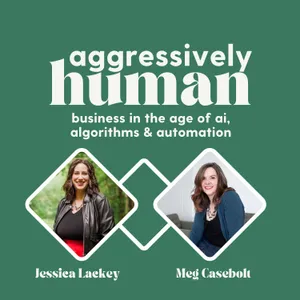
by Meg Casebolt & Jessica Lackey
In a world focused on more: more content, more followers, more marketing, more scale, more noise… we’re facing less trust, less contact, less reach. We’re drowning in AI-generated slop, being pitch-slapped by “personalized” email funnels that couldn’t be farther from authentic, and struggling to be seen by a pay-to-play algorithm. It’s never been easier to create and connect more cheaply and at more scale, with less trust and more skepticism.But for experts and service-based businesses? We’re seeing the pendulum swing back. The answer isn’t to play by these trends. It’s to be **aggressively human.** aggressivelyhuman.substack.com
Latest Episodes
The most recent episodes — sign up to get AI-powered summaries of each one.
- 4 days ago57 min
Humanizing Data (and Strengthening Sales) with Tanisha Tate Woodson
Most research gets done to communities: someone extracts the data, publishes the paper, and is never heard from again. Tanisha Tate Woodson built a firm on the opposite premise — and then did the less glamorous thing, which was turn that premise into an actual codified method.In this episode, we talk with Tanisha Tate Woodson, who runs Woodson Insights Research and Evaluation, working with nonprofits, government agencies, and funders to humanize data and show the impact of their work. She walks us through her approach: four dimensions that get dialed up or down for every engagement, culturally responsive methods that let people tell their stories the way they actually want to, and a sense-making session at the end so the report doesn’t die on a shelf. Then we get into what having a method has done for the business. Tanisha’s RFP win rate is around 50% in a field where 15-20% is normal, because she’s bidding on one or two instead of five and can answer a proposal from a process she’s already written down. She built an AI skill that knows her red flags and tells her when to pass. And she’s growing on referrals and community relationships with limited social media presence. This is a meta episode — premise, method, methodology in action.* Storytelling as data: why observation and conversation are data, not just spreadsheets* Why funders and the nonprofits they fund are speaking two different languages* Research done to communities vs. research done with them — and the harm history behind the suspicion* Why every engagement ends with a two-to-three-hour sense-making session, not a report on a shelf* The through line from a promise made to a community to an artifact that actually goes back to them* The four dimensions that get dialed up or down for every client — and the myth that community-engaged work is less rigorous* Culturally responsive method in practice: PhotoVoice, video, and a focus group built on Chutes and Ladders* Building the Black Data Pulse panel so recruitment stops eating clients’ budgets* Why a codified process doubled her RFP win rate — and how she decides what not to bid on* Using AI as a trained junior team member, not a proposal generator* Growing a business on relationships and referrals with no Instagram account* What “know yourself first” has to do with whether your AI output sounds like you“There’s a huge myth in the field that when you’re close to the communities, when you’re doing community engagement work, it’s no longer rigorous, and that’s not true. It’s more rigorous because now we’re embedding community perspectives into their work. We’re not only embedding them into the work, but we’re also articulating the cultural relevance of the work that we’re doing.Are people telling the stories in a way in which they wanna be told? So if, for instance, if you wanna hear from students, do students wanna take a survey? No. So we think about the culturally responsive methods as also thinking about who you wanna hear from and how do they want their stories to be told.” - Tanisha Tate WoodsonAbout our GuestWoodson InsightsConnect with UsListen on SpotifyListen on Apple PodcastsMeg CaseboltJessica Lackey This is a public episode. If you would like to discuss this with other subscribers or get access to bonus episodes, visit aggressivelyhuman.substack.com
- 1 weeks ago56 min
Cold outreach... as a human?!?
Most of us have a very specific image of cold email: a stranger who never heard of us, selling something we never wanted, in language no human being would actually use. But “cold email” just means an email to someone who doesn’t know you yet—and the version most of us are reacting to is only one way to do it.In this episode, we talk with Laura Lopuch, who helps online service providers start conversations with high-quality leads through cold outreach. She built the WARM framework and the Warm Client Method, and her whole argument is that the leads you want are already out there leaving public signals about the problems they have—you just have to do the research before you hit send.We talk about what qualifying someone actually looks like from the outside, how to name a prospect’s blind spot without insulting them, why “are you interested?” is a better ask than “book a call,” and where the follow-ups fit. We discuss the reality of dealing with inbox overwhelm, how to stand out from the volume of terrible cold outreach, and why outreach isn’t just for prospecting. * What a cold email actually is—and why the transactional “buy my stuff” version is a myth* Gap signals: reading the public evidence that someone has the problem you solve* How to infer budget, team size, and urgency before you ever send an email* Naming a blind spot without negging—using outside research instead of “your brand is bad”* Consent-based outreach and why “are you interested?” is the right-sized ask* Micro-yeses in the email vs. escalating-commitment persuasion tactics (they’re not the same thing)* Fast burn vs. slow burn: sales emails, podcast pitches, collaborations, workshops, JVs, sponsorships* Whether this works for B2C and coaching, not just B2B services* Laura’s actual numbers—reply rate, conversion rate, and why the wins live in the follow-ups* Why the low bar in everyone’s inbox is good news for anyone willing to sound like a person“A lot of people get confused when I say relevant, and they're like, 'Yeah, first name, company.' And it's not actually that. That's personalization. That's icing on the cake. The relevancy is the deeper method of tapping into what is this person's existing goal? What are they working towards? Are they working to sell their agency in five years? If so, they need a controllable source of getting new clients in the door, one that doesn't depend on algorithms.” - Laura LopuchAbout our GuestLaura LopuchThe WARM Client MethodConnect with UsListen on SpotifyListen on Apple PodcastsMeg CaseboltJessica Lackey This is a public episode. If you would like to discuss this with other subscribers or get access to bonus episodes, visit aggressivelyhuman.substack.com
- 2 weeks ago58 min
How we designed our fall programs (and who they're actually for)
Most program pages tell you what you get — the calls, the modules, the bonuses. They almost never tell you why the thing is six weeks instead of six months, or why the schema markup lesson moved from week three to week six.In this episode, we walk through our own fall programs: Meg’s Signal, a year-long mentorship focused on AI discoverability, and the seventh round of Jessica’s Define Your Foundations cohort. We’re not pitching them so much as taking them apart — what’s in each phase, what order things go in, what we changed after watching people get stuck, and what we’ve learned about how long it actually takes for work to sink in.We talk about why Meg teaches live twice a year instead of going evergreen, why Jessica spread the “intellectual horsepower” decisions across six months instead of front-loading them, how the BEACON framework maps to positioning work, and where our two programs hand off to each other. We also get honest about who each program isn’t for.* Why the length of a program should be dictated by what’s actually in itSignal Details:* Meg’s Signal: four three-month cycles, and why it’s a mentorship, not a membership* Why “learn it twice” beats “learn it once” — and what happens between the training cycles* Why Meg won’t make the program evergreen (spoiler: the material changes every six months)* The BEACON framework: brand entity, expertise, authority, content infrastructure, omni-channel presence, narrativeDefine Your Foundations Details:* Jessica’s four phases in Define Your Foundations — and why phase one is setting down the shoulds* “Business model Tetris”: how your client, offer, and price point change what marketing you actually need* Why front-loading every big decision makes people feel behind* Co-working and laser coaching vs. office hours — designing for people who don’t ask questions in groups* The three things that separate cohort members who get results from those who don’tWhich Program Might Be Right for You:* Where positioning work ends and discoverability work begins (and which one to do first)* Who each program is not for“There’s another business coach who does a six-week accelerator, and she goes through her six core systems, because she has six systems similarly. And I’m like, ‘that is like pouring a flood of water onto concrete.’ It’s so fast. Her whole thing is fast, and my philosophy is that if you try to learn six full business systems in six weeks, you’re not gonna retain any of it.So my point of view is not just about what the systems are, but how it informs the offer itself and the client I’m serving. And if they want speed, awesome. My narrative has to connect to what I’m selling and why.” - JessicaResourcesSignal — Meg’s year-long mentorship programDefine Your Foundations — Jessica’s six-month cohortThe Deeper Foundations Membership Connect with UsListen on SpotifyListen on Apple PodcastsMeg CaseboltJessica Lackey This is a public episode. If you would like to discuss this with other subscribers or get access to bonus episodes, visit aggressivelyhuman.substack.com
- 3 weeks ago44 min
Why We Need a Party for Our Failures with Jess Manuszak
[A note before you listen: This episode includes candid discussion of suicide, suicidal ideation, mental health crisis, psychiatric hospitalization, addiction, and chronic illness. Please take care of yourself — skip it, save it for later, or listen with someone.]Failure is one of the only universal experiences in business, and it’s also the one we’re least willing to say out loud. Most of the time when failure does get talked about publicly, it’s been sanded down into a tidy redemption arc or it’s behind a paywall. Jess Manuszak decided to throw a party instead.In this episode, we talk with Jess Manuszak, owner of the Denver copywriting studio Verve and Vigour and founder of The Failure Ball, a biannual black-tie event where people get on stage in gowns and crowns and tell the truth about how they failed. The Ball started in 2020 with a goal of 30 attendees, sold out at 78, and last year filled a Victorian mansion with 200 people. All profits go to To Write Love On Her Arms, because the connection between shame and suicide is exactly why the event exists. The next one is September 19, 2026 in Denver.We talk about the difference between the failures we actually caused and the ones the online business world decided to call failures, why the format has to be in-person (and glamorous, and not under fluorescent lights), and how to know when your story belongs on a stage versus in your therapist’s office. * Why shame festers when failure gets left in the dark* The rule that a failure has to be one you actually caused* Getting a job isn’t a business failure — but the industry treats it like one* Why the format is a ball, not a summit, a conference, or a podcast* The failure behind the failure: what speaker coaching actually uncovers* “You don’t have to turn your trauma into content” — and how to know when you want to* Knowing why you’re sharing: to feel less alone, to be witnessed, or to get input* Where the line sits between authenticity as a human and your brand’s story* Holding space for clients versus asking clients to hold space for you* Why at least one Failure Ball speaker every year is actively failing, with no gold bow on it“We know the psychology behind shame. We know that the antidotes to shame are community, non-judgment, sharing, and self-kindness. That’s really what we’re here for — drag your dark secrets into the light. You feel like they’re so dirty. Bring them into this room and you’ll see how squeaky clean they actually are, because I guarantee someone in this room relates. It’s the failure behind the failure. Everybody wants to be loved. If you’ve had a launch that failed, maybe everyone hasn’t lost a million dollars at launch, but everybody wants to try to have financial stability in their life. It’s those underlying threads that connect everyone and help heal that trauma — versus, for $27 in four installments, we will heal your shame for you.” — Jess ManuszakResources ReferencedThe Failure BallMike Ganino’s episodeNicole Lewis-Keeber’s episodeConnect with UsListen on SpotifyListen on Apple PodcastsMeg CaseboltJessica Lackey This is a public episode. If you would like to discuss this with other subscribers or get access to bonus episodes, visit aggressivelyhuman.substack.com
- Aug 20, 202653 min
The secret to becoming referable
We’re both getting pitched constantly by emails that clearly came from a bot that scraped our show notes, and the reason they don’t work isn’t the outreach itself. It’s that there’s no distinct perspective behind it.In this episode, we talk about the chicken-and-egg problem underneath developing a reputation and referrals: you need a point of view to get in the room, but you need to be in rooms with actual humans to sharpen a point of view. We get into why AI-workshopped positioning defaults to the average of what everyone else is already saying, what it actually takes to be referable, and how long it really takes for an angle to become something people seek you out to talk about.We’re honest about the awkwardness of testing out your language with other humans and provide a “call me when” framework to help you sharpen your positioning for your network and for AI. * The chicken-and-egg problem: needing a POV to get in the room, and needing the room to build a POV* What it actually takes to be referable: category, persona, approach/angle* The “Call Me When” exercise, and why specific scenarios are often clearer than results-based messaging* Semantic vs. somatic: reading the face of the person you just pitched* The “take your name off of your website” test* Why “I could do that” is a trap, and how naming what you don’t do tightens your referrals* The three-year timeline of turning a topic into inbound requests* Being known for a feeling, not just a framework* The linguistic throat-clearing AI adds, and how to cut 20–30% of it“The perspective has to come first. The uniqueness, the differentiator has to come first. Because people are busy, inboxes are crowded, DMs are full of garbage, and if your pitch sounds like everyone else’s pitch, or if your website sounds like everyone else’s website, or if your email sounds like everyone else’s email, then I don’t care how many times you workshop it — I could take your name off of it and put someone else’s name on it, then I’m not gonna hire you. I’m not gonna bring you into my membership. I’m not gonna bring you on the podcast. You might be the nicest human alive, but if I don’t hear something different in your messaging, then I don’t know how to amplify your message.” - MegResources ReferencedAngie Stegall - CoachSharon Wagner - BrandingHillary Weiss Presswood - CampaignsConnect with UsListen on SpotifyListen on Apple PodcastsMeg CaseboltJessica Lackey This is a public episode. If you would like to discuss this with other subscribers or get access to bonus episodes, visit aggressivelyhuman.substack.com
- Aug 13, 20261h 3m
Making a lifetime of work legible with Jessica Abel
Most of us who work for ourselves aren’t one clean thing—we’re cartoonists who also teach, consultants who also write, coaches who also run the whole business. And after a couple decades of that, you can end up with an enormous body of work that almost nobody can actually see, least of all the AI tools now deciding who you are. To talk through what to do with a career’s worth of ideas, we’re bringing on Meg’s friend, colleague, and client, Jessica Abel.Jessica is a cartoonist and author turned business coach for professional creatives, helping them finish the self-generated work that has no deadline and get paid well enough to actually have time for it. In this episode, she walks us through the very unglamorous process of taking 10-plus years of courses, newsletters, and frameworks, most of it locked behind paywalls or buried in podcast audio, and making it cohesive and legible for both people and AI. She and Meg get honest about why podcasting is great for ideas and terrible for discoverability, what it actually takes to update a Wikipedia page, and why The Guardian counts as proof but a marketing podcast doesn’t.We talk about the difference between productivity and capacity, why “decide” and “reflect” are the phases everyone skips, and what it means to pay yourself first with your time instead of your leftover minutes. We get into cyclical burnout, idea debt, and the genuinely hard work of deciding what you’re not going to do—and being at peace with it.* Why “multi-hyphenate” isn’t a bug of entrepreneurial life* Cyclical burnout: what happens to someone who always has new ideas* How Jessica consolidated a career-long body of work into something legible using a bottom-up, feedback-driven process (and Claude)* Capacity as a lens—not just your time, but your neurological and emotional bandwidth—and why it fluctuates by the day and the season* Grow work vs. build work, and the tension between expanding your audience and cementing a legacy* What it actually takes to be legible online—AI discoverability, entity confusion, and why Jessica still shows up as a cartoonist first* The Creative Engine’s four phases—collect, decide, act, reflect—and why decide and reflect get skipped even though they’re the shortest* The “flexible container”: building a finishing structure with edges that can still absorb a sick kid or a health flare-up"I actually hate the word productivity and try to not talk about myself as a productivity coach, because—I still have to use it a lot 'cause it's the word people know. But productivity literally means: how do you have the same amount of capacity and jam more stuff into it? How do you get more stuff out of whatever you have available? And of course you can look at it different ways, but that's literally what it means in the economic sphere. Which is just a point of view that doesn't work for humans, and especially creatives and people who have big ideas and are trying to do the self-generated stuff." —Jessica AbelAbout our GuestJessica AbelOut on the WireIn the WeightsConnect with UsListen on SpotifyListen on Apple PodcastsMeg CaseboltJessica Lackey This is a public episode. If you would like to discuss this with other subscribers or get access to bonus episodes, visit aggressivelyhuman.substack.com
- Aug 6, 202647 min
We're back! Our summer hiatus recap
Aggressively Human went on hiatus for July, and we’re back to talk about what the break actually looked like!In this episode, we catch up on what our month off actually looked like — Jessica’s West Coast “book tour” meeting Deeper Foundations members across four cities, and Meg’s glaucoma surgery and a quieter, more foundational summer of business work. We talk about travel, illness, eye surgery, membership relaunches, and the discomfort of resting without immediately filling the space with something new — plus why a genuine pause turned out to be exactly what both the business and the podcast needed.* Why Jessica took her book on an unofficial “tour” through Seattle, Portland, San Francisco, and LA* The public transit challenge: one rideshare in twelve days across four major cities* Meg’s glaucoma surgery, what a week without screen time actually looks like, and why she scheduled it for the slow season* What it actually looks like to let go of “big, hairy, ferocious projects” for a season without the business falling apart* Relaunching the Deeper Foundations membership without ever having done a formal launch sequence before* The “collective pause”: a shared sense that clients, colleagues, and the industry at large all pulled back at the same time this summer* Why reflection is the step that gets skipped in a weekly podcast cadence — and why that’s a problem worth solving* The World Cup as a rare moment of monoculture in an increasingly fractured media landscape* What “resting but not regenerating” feels like when travel and motion replace actual stillness“I think sometimes when you’re in a production content creation process, you don’t have a chance for reflection. When it comes to podcasting, because of the weekly cadence, you’re always gathering ideas, lining up guests, and thinking about what you want to talk about. Then we have to get together, we have to record, we have to produce, we have to create the show notes — we have to do all these different things. And that fourth step, reflect, is the easiest one to miss, because the cadence has been determined, and we lose sight of what it is we’re trying to do here.” -MegResourcesLeaving the CasinoJust for the Summer by Abby JimenezSuccubus Blues series by Richelle Mead School of Moxie with Mary WilliamsConnect with UsListen on SpotifyListen on Apple PodcastsMeg CaseboltJessica Lackey This is a public episode. If you would like to discuss this with other subscribers or get access to bonus episodes, visit aggressivelyhuman.substack.com
- Jun 25, 202621 min
Our summer downshift (and our July podbreak)
Taking the whole month of July off breaks the weekly cadence we’ve held all year—and one of us is famously bad at taking time off. But this isn’t a best-of rerun or a quiet fade; it’s a deliberate choice to downshift, and we wanted to talk openly about why we’re making it and what it actually takes to pull off.In this episode, we get into what’s behind our summer sabbatical: the planning required to step away (turns out you have to prep in advance), why listenership naturally dips in the summer, and why we decided against reposting old episodes under a “best of” label. Meg talks about her seasonal rhythm—short summers in a cold climate, kids’ camp schedules, less desire to sit at a microphone—and Jessica walks through a stretch of heavy travel, a meaningful family transition, and finally having the room to take a real beat.We talk about the difference between maintaining and growing, why a body of work keeps earning for you even when you slow down, and the case for “mental composting” as actual business strategy. We also get into relationship marketing that doesn’t look like marketing, and why taking time off doesn’t mean you’re bad at your business. Plus a live tarot pull that may or may not predict another book.* Why we’re taking all of July off—and why it’s a sabbatical, not just a slowdown* The prep it actually takes to step away (hint: start two to three months out)* How summer listenership shifts when everyone’s out living their lives* Meg’s seasonal rhythm: cold-climate summers, camp schedules, and working less on purpose* Jessica’s summer of travel, a family transition, and finally taking a beat after years of building* Why a “body of work” keeps working for you when you stop pushing* Mental composting and the case for creative downtime (see: Lin-Manuel Miranda in an airport)* Maintaining vs. growing—and why you don’t always have to be in growth mode"Taking time off doesn't mean you're bad at your business. But it does mean that if we're going to take time, we need to prepare for that two to three months in advance. Otherwise it's that vacation-y feeling where you cram. I don't have a whole bunch of curriculum that I'm creating. I'm not writing and launching the book. I'm at a place where I can take a beat, so I'm gonna take it. Past Jessica did a good job, present Jessica is gonna take advantage of that, and future Jessica already knows what she's doing in August and September. There's more launches coming. They're just not happening in July." -JessicaConnect with UsListen on SpotifyListen on Apple PodcastsMeg CaseboltJessica Lackey This is a public episode. If you would like to discuss this with other subscribers or get access to bonus episodes, visit aggressivelyhuman.substack.com
About Aggressively Human: Online Business in the Age of AI, Algorithms & Automations
In a world focused on more: more content, more followers, more marketing, more scale, more noise… we’re facing less trust, less contact, less reach. We’re drowning in AI-generated slop, being pitch-slapped by “personalized” email funnels that couldn’t be farther from authentic, and struggling to be seen by a pay-to-play algorithm. It’s never been easier to create and connect more cheaply and at more scale, with less trust and more skepticism.But for experts and service-based businesses? We’re seeing the pendulum swing back. The answer isn’t to play by these trends. It’s to be **aggressively human.** aggressivelyhuman.substack.com
Customized Recaps
AI-powered recaps with compact key takeaways, quotes, and insights.
Straight to Your Inbox
Get key takeaways from Aggressively Human: Online Business in the Age of AI, Algorithms & Automations in a 5-minute read.
Save Hours Every Week
Stay current on your favorite podcasts without falling behind.
Frequently Asked Questions
What is Podzilla's Aggressively Human: Online Business in the Age of AI, Algorithms & Automations daily summary?
It's a free AI-powered email that summarizes new episodes of Aggressively Human: Online Business in the Age of AI, Algorithms & Automations as soon as they're published. You get the key takeaways, notable quotes, and links & mentions — all in a quick read.
How does the Aggressively Human: Online Business in the Age of AI, Algorithms & Automations podcast summary work?
When a new episode drops, our AI transcribes and analyzes it, then generates a personalized summary tailored to your interests and profession. It's delivered to your inbox every morning.
Is this an official Aggressively Human: Online Business in the Age of AI, Algorithms & Automations product?
No. Podzilla is an independent service that summarizes publicly available podcast content. We're not affiliated with or endorsed by Meg Casebolt & Jessica Lackey.
Can I get summaries of other podcasts too?
Absolutely! The free plan covers up to 3 podcasts. Upgrade to Pro for 15, or Premium for 50. Browse our full catalog at /podcasts.
How often does Aggressively Human: Online Business in the Age of AI, Algorithms & Automations release new episodes?
Aggressively Human: Online Business in the Age of AI, Algorithms & Automations publishes weekly. Our AI generates a summary within hours of each new episode.
What topics does Aggressively Human: Online Business in the Age of AI, Algorithms & Automations cover?
Aggressively Human: Online Business in the Age of AI, Algorithms & Automations covers topics including Technology, Business. Our AI identifies the specific themes in each episode and highlights what matters most to you.
Start getting Aggressively Human: Online Business in the Age of AI, Algorithms & Automations summaries tomorrow morning.
Free forever for up to 3 podcasts. No credit card required.
Free forever for up to 3 podcasts. No credit card required.