Free Daily Podcast Summary
Age of the Dinosaurs: Daily Summaries Delivered
by Fun Kids
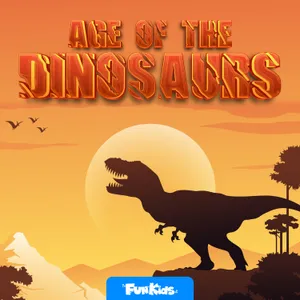
Travel back in time to 145 million years ago and discover what life was like when dinosaurs roamed the Earth ... Dive underwater and meet the strange species living at the bottom of the sea and get up close with the terrifying Tyrannosaurus Rex!
Latest Episodes
The most recent episodes — sign up to get AI-powered summaries of each one.
- Today32 min
What the thagomizer?! with ReBecca Hunt-Foster
If something wants to eat you, you have three options: get so big that knocking you over is not worth the trouble, get fast enough to leave, or make yourself so expensive to attack that nobody bothers. Plenty of dinosaurs took the third one, and they did it by growing bone inside their own skin. Not armour they put on, but armour they were, down to bony eyelids in the case of Ankylosaurus. This week’s word is thagomizer, the cluster of spikes on the end of a Stegosaurus tail, and it is the only piece of dinosaur anatomy named by a newspaper cartoon. Gary Larson drew one in The Far Side in 1982, with a caveman lecturing his class and crediting “the late Thag Simmons”. Thag Simmons never existed. Palaeontologists liked the word too much to let that stop them, and it stuck. It describes something genuinely dangerous: there is an Allosaurus bone with a thagomizer-sized hole punched through it, which had begun to heal before the animal died. Fresh from the Dig is all armour. Two vertebrae collected in the 1950s, filed as sauropod and left in a display case, turn out at 27 and a half and 29 inches to belong to the largest Stegosaurus known. Vectipelta barretti, an armoured dinosaur from the Isle of Wight, is named after Professor Paul Barrett of the Natural History Museum by colleagues who wanted to honour his work on exactly this kind of dinosaur. And Sophie, about 85 per cent of a skeleton and the most complete Stegosaurus ever found, whose skull was the first preserved well enough to show what a Stegosaurus head actually looked like. She weighed 1.6 tonnes and was not fully grown. Lauren and Cassius are joined by Dr ReBecca Hunt-Foster, the monument palaeontologist at Dinosaur National Monument in Utah, whose office is essentially a cliff with about 1,500 dinosaur bones still stuck in it. She explains how a Diplodocus turned up under a car park that was being repaved, and why more of it was deliberately left in the ground for whoever digs next; how clam fossils found open rather than shut are the evidence for the drought that killed the animals in the quarry; and how a single foot was enough to name a new species. Her advice on armour: cover your back, your sides and your neck. Freya, who is nine and from Newcastle, wants to know whether the plates on a Stegosaurus were for fighting or for showing off, and palaeontology has been arguing about it for a century. Then it is Build a Dino Lab, where one real fact becomes one real piece of the perfect dinosaur. Week four is tank or knight, and Lauren goes for plates, shoulder spikes and a thagomizer, because full ankylosaur armour on a dinosaur built to run would slow it to a crawl. Next week, where all of this lived, and a scientist whose fossils are smaller than a grain of sand.See omnystudio.com/listener for privacy information.
- 1 weeks ago38 min
Dinosaurs never needed a dentist with Emma Nicholls
Nigersaurus grew around 500 teeth and replaced the whole lot roughly every two weeks. It never brushed them, never had to be careful with them and never once saw a dentist, because there was always another tooth coming up behind. The word for that is polyphyodont, and it is this week’s word. Humans get two goes. Milk teeth, then the set we are stuck with. Sharks, crocodiles and most dinosaurs are on a conveyor belt instead, and that changes what a tooth can be. If breaking one costs you nothing, your teeth are free to evolve into exactly the right shape for the job rather than something built to survive a fight, which is how theropods ended up with thin serrated blades in their mouths. Lauren and Cassius go to the Oxford University Museum of Natural History to meet Dr Emma Nicholls, who looks after 40,000 fossil animals, anything with a backbone. She explains that sharks have no bones at all, only cartilage, the same stuff as your ear, which is why nearly all we have of them is teeth. One tooth is enough to work out a great deal. Tall, thin and triangular means a fast pursuit predator shaped like a great white. Flat and crushing means something on the seafloor eating sea urchins. She also spent three weeks digging up the Rutland Sea Dragon, a ten-metre ichthyosaur found in a drained reservoir in the middle of England, and points out that it looks almost identical to a shark despite being a reptile and not related to one at all. Fresh from the Dig has Nigersaurus, nicknamed the sauropod lawnmower, whose fortnightly new set makes sense once you know it fed off the ground and swallowed grit with every mouthful. Diplodocus, eating higher up, got about 35 days out of a set. Plus the Oxford museum’s rebuilt fossil gallery, where Megalosaurus, named in 1824 and the first dinosaur ever described, is joined by a young Eustreptospondylus going on public display for the first time, part real bone and part 3D print. And Cassius’s own research reading the scratches and pits on theropod teeth under a microscope, with something from the UK he is not allowed to tell us about yet. Moosa, who is seven and from Leicester, wants to know whether dinosaurs ever got toothache. Then it is Build a Dino Lab, where one real fact becomes one real piece of the perfect dinosaur. Week three is slicers or crushers, and Lauren goes for tall, thin, curved, serrated theropod teeth, because a fast two-legged dinosaur chasing shellfish would be a waste of a good pair of legs. Next week, something bigger, and a word invented by a cartoonist.See omnystudio.com/listener for privacy information.
- 2 weeks ago32 min
Dinosaurs with necks full of air with Mike Taylor
The longest neck any animal has ever grown belonged to Mamenchisaurus, and the neck on its own was more than 15 metres, longer than a school bus before you even get to the rest of the dinosaur. Which raises the obvious question: how do you hold something like that up? The answer is that mostly you don’t have to, because sauropod neck bones were never solid. They were full of air. That is this week’s word. Pneumatic bone is built like a honeycomb, riddled with air spaces a millimetre or two across, which makes it far lighter and, oddly, no weaker at all. Birds have the same trick, which is part of how they get off the ground, and birds are dinosaurs. On Mamenchisaurus roughly half the animal’s total length was neck, carried on as many as 19 neck bones. A giraffe, the record holder among mammals at 2.2 metres, manages with seven. So do you. Fresh from the Dig has a Diplodocus found underneath a car park at Dinosaur National Monument in Utah, where people had been parking on top of it for years. Only the part in the way of the building work has been dug out, and the rest has been left in the ground for future palaeontologists. Plus Mamenchisaurus and its two seconds of screen time in The Lost World, and Cetiosaurus, the whale lizard, dug up in Oxfordshire and named in 1841 by Richard Owen, who took one look at bones that size and decided they had to belong to a whale. It was the first long-necked dinosaur ever named, and it is stuck with the name. Lauren and Cassius are joined by Dr Mike Taylor, a computer programmer by day who studies sauropod necks in the evenings. He explains why taking bone out of the middle of something makes it stronger rather than weaker, suggests boiling down a turkey neck at Christmas so you can see the air spaces for yourself, and points out that nobody needs permission to do palaeontology. Two of his colleagues had their first scientific papers published while they were still at school. Elsie, who is eight and from Bristol, wants to know how many bones are in a sauropod’s neck. Then it is Build a Dino Lab, where one real fact becomes one real piece of the perfect dinosaur. Week two is long neck or short, and Lauren goes short, because 15 metres of neck on a two-legged dinosaur ends with its face in the mud. See omnystudio.com/listener for privacy information.
- 3 weeks ago29 min
The dinosaurs that ran faster than Usain Bolt
Dinosaurs ruled for 160 million years, and the thing that made them a runaway success was where their legs went. Not out to the side like a crocodile, but straight down underneath them, a stance that costs less energy and frees the arms up for other work. So how fast could they actually go? Footprints in Inner Mongolia, laid down 120 million years ago, put a medium-sized meat eater at around 45 kilometres an hour, quicker than Usain Bolt at his peak, and trackways in La Rioja in Spain clock theropods at almost exactly the same speed. A quarry in Oxfordshire turned up a dinosaur highway of nearly 200 footprints running over 150 metres, made by long-necked sauropods and by Megalosaurus, the first dinosaur ever named, back in 1824. Brazil has gone one better with Farlowichnus, a dinosaur named from nothing but its footprints, no bigger than a long-legged bird. And Tyrannosaurus rex, the one everybody assumes was quickest, was nothing of the sort. Lauren and Cassius are joined by Professor John Hutchinson of the Royal Veterinary College, who rebuilds dinosaurs inside a computer, gives them muscles and physics, and makes them run. He worked out that a seven-tonne T. rex would have needed around three tonnes of leg muscle to sprint, more than half its body, and the force would have snapped its legs, so it managed something closer to a brisk 15 miles an hour. He also refuses to say the legs are the most important part of a dinosaur. He says it is the pelvis, because the hips tell you what the animal actually did. Then it is time for Build a Dino Lab, where one real fact becomes one real piece of the perfect dinosaur. For week one the choice is two legs or four, and Lauren goes bipedal, because speed is useful whether you are running away from something or running towards fresh fruit. Next week, necks.See omnystudio.com/listener for privacy information.
- 4 weeks ago0 min
This is Dino Quest
Legs that could outrun the fastest human alive. A neck longer than a double-decker bus. A tail people were once sure could crack like a whip. Every week Lauren and Cassius dig up one brand new, completely true fact about dinosaurs, and use it to add one piece to a dinosaur they are building themselves, one bone at a time. They call up real scientists, get into discoveries that are barely out of the ground, and answer the questions listeners send in. Along the way: why the pigeon on your windowsill counts as a dinosaur, and why you have almost certainly eaten part of a T. rex. Dino Quest. Follow wherever you get your podcasts so you never miss an episode.See omnystudio.com/listener for privacy information.
- Nov 15, 20114 min
Cretaceous Period: Tyrannosaurus Rex
Around this time, there were more dinosaurs than ever before. It's also where you’d find one of the best known dinosaurs of them all – the Tyrannosaurus Rex! Join Fun Kids Podcasts+: https://funkidslive.com/plusSee omnystudio.com/listener for privacy information.
- Nov 12, 20114 min
Cretaceous Period: Living alone or in herds?
The world by this point was home to a wider variety of environments and species than ever before... and different species behaved in different ways – some preferring to live on their own, others liking the company of the herd.Join Fun Kids Podcasts+: https://funkidslive.com/plusSee omnystudio.com/listener for privacy information.
- Nov 10, 20114 min
Cretaceous Period: Sea Life
More varieties of animals and plants lived at the time than ever before – from the dinosaurs on the land to the plants they ate. Things were getting pretty busy underwater too...Join Fun Kids Podcasts+: https://funkidslive.com/plusSee omnystudio.com/listener for privacy information.
About Age of the Dinosaurs
Travel back in time to 145 million years ago and discover what life was like when dinosaurs roamed the Earth ... Dive underwater and meet the strange species living at the bottom of the sea and get up close with the terrifying Tyrannosaurus Rex!
Customized Recaps
AI-powered recaps with compact key takeaways, quotes, and insights.
Straight to Your Inbox
Get key takeaways from Age of the Dinosaurs in a 5-minute read.
Save Hours Every Week
Stay current on your favorite podcasts without falling behind.
Frequently Asked Questions
What is Podzilla's Age of the Dinosaurs daily summary?
It's a free AI-powered email that summarizes new episodes of Age of the Dinosaurs as soon as they're published. You get the key takeaways, notable quotes, and links & mentions — all in a quick read.
How does the Age of the Dinosaurs podcast summary work?
When a new episode drops, our AI transcribes and analyzes it, then generates a personalized summary tailored to your interests and profession. It's delivered to your inbox every morning.
Is this an official Age of the Dinosaurs product?
No. Podzilla is an independent service that summarizes publicly available podcast content. We're not affiliated with or endorsed by Fun Kids.
Can I get summaries of other podcasts too?
Absolutely! The free plan covers up to 3 podcasts. Upgrade to Pro for 15, or Premium for 50. Browse our full catalog at /podcasts.
How often does Age of the Dinosaurs release new episodes?
Age of the Dinosaurs publishes every few days. Our AI generates a summary within hours of each new episode.
What topics does Age of the Dinosaurs cover?
Age of the Dinosaurs covers topics including Kids & Family, Family. Our AI identifies the specific themes in each episode and highlights what matters most to you.
Start getting Age of the Dinosaurs summaries tomorrow morning.
Free forever for up to 3 podcasts. No credit card required.
Free forever for up to 3 podcasts. No credit card required.