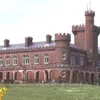
Welcome back to “A Scottish Castle, A Day,” brought to you by bagtownclans.com. I’m your host, Colin MacDonald, and today we’re heading to the rugged Isle of Rum, one of the remote and mystical Small Isles off the west coast of Scotland, to explore the grand, eccentric, and controversial Kinloch Castle. This Edwardian mansion, built by industrialist Sir George Bullough, stands as a monument to a bygone era of extreme wealth, indulgence, and the opulent lifestyle of the British elite. Its story is a fascinating mix of luxury, invention, and controversy, and it remains one of the most enigmatic structures in the Scottish Highlands.To understand the grandeur of Kinloch Castle, we must first go back to the 19th century, to the origins of the Bullough family’s fortune. George Bullough inherited the Isle of Rum in 1891, following the death of his father, John Bullough. John was a self-made man, a Lancashire textile magnate who co-founded Howard & Bullough, a manufacturing company that played a key role in the industrial revolution. The company’s vast Globe Works in Accrington employed half of the town’s population at its height, and the Bulloughs quickly became one of the wealthiest families in Britain.The Isle of Rum entered the Bullough family’s story in 1879 when John Bullough, seeking a Highland retreat for hunting, leased the island as a shooting estate. A few years later, he purchased the entire island for £35,000, marking the beginning of the family’s connection to this remote Scottish isle. The estate came complete with the modest Kinloch House, a building constructed in the 1820s by Dr. Lachlan McLean, who had cleared the island’s inhabitants as part of the infamous Highland Clearances.But after John’s death, young George Bullough was not content with the simplicity of Kinloch House. By 1897, he embarked on a grand vision, commissioning the construction of Kinloch Castle, a stately home that would embody the height of Edwardian luxury and excess. Employing 300 men, most of them brought over from Lancashire and the nearby island of Eigg, construction on the castle began. Built from red sandstone quarried on the Isle of Arran, the castle rose out of the rugged landscape of Rum, overlooking the tranquil waters of Loch Scresort.The lavishness of Kinloch Castle knew no bounds. Inside, it was filled with extravagant furnishings and cutting-edge technology, some of which still amazes visitors today. Bullough had installed his own hydroelectric power plant, ensuring that his castle was one of the few places in Scotland with electric lighting at the time. Central heating, double glazing, air conditioning, and a state-of-the-art telephone system were all installed, making the castle a technological marvel of its day. And the crown jewel of the home’s indulgent features? An orchestrion—a mechanical music machine that could simulate the sound of an entire orchestra, offering entertainment for guests without the need for live musicians.Bullough’s penchant for eccentricity didn’t stop at technology. His personal menagerie at the castle included pet alligators, giant turtles, and, in a now-lost conservatory, hummingbirds. The gardens surrounding Kinloch Castle were just as grandiose, with formal layouts, exotic plantings, and even a walled garden briefly home to alligators. The landscaping required 250,000 tonnes of soil to be imported from Ayrshire, a staggering feat of Victorian engineering and excess.For nearly four decades, Kinloch Castle was the site of lavish parties, hunting excursions, and high society gatherings. George Bullough, later knighted for his contributions during the Boer War, hosted an array of celebrities, nobility, and even royalty. His half-brother Ian’s wife, Lily Elsie, was a star of Edwardian theater and brought an extra dash of glamour to the events hosted on Rum. But despite its grandeur, Kinloch Castle became a symbol of the excesses of the British aristocracy, a controversial monument to wealth in an era when the gap between rich and poor was starkly visible.By the time George Bullough passed away in 1939, the heyday of Kinloch Castle had long faded. The Bullough family’s estate went into trusteeship, and by the late 1950s, the island and castle were sold to the government agency responsible for natural heritage, now known as NatureScot. The castle and the island of Rum were designated a National Nature Reserve, but the castle itself began to fall into disrepair.In recent decades, efforts have been made to save this crumbling piece of history. In 1996, the Kinloch Castle Friends Association was formed to help preserve the building and its contents. In 2003, Kinloch Castle featured on the BBC series Restoration, narrowly missing out on a £3 million grant to fund much-needed repairs. Despite this setback, the castle attracted the attention of Prince Charles, leading to ongoing discussions about how best to preserve this uniq
Podzilla Summary coming soon
Sign up to get notified when the full AI-powered summary is ready.
Free forever for up to 3 podcasts. No credit card required.
Listen to This Episode
Get summaries like this every morning.
Free AI-powered recaps of A Scottish Castle A Day and your other favorite podcasts, delivered to your inbox.
Free forever for up to 3 podcasts. No credit card required.