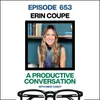
From Routines to Rituals: How to Stop Living on Autopilot and Start Living on Purpose (with Erin Coupe)
This episode is sponsored by Focusaur — an AI-powered focus console built for deep work and daily habits. If your phone keeps pulling you away from your best work, Focusaur creates the physical friction that gives you your focus back. They're in the final days of their Kickstarter campaign. Visit mikevardy.com/focusaur to learn more.Most of us aren’t burned out because we’re doing too much. We’re burned out because we’re doing too much of the wrong things — on autopilot, running inherited scripts, and mistaking busyness for meaning. The distinction between a routine and a ritual sounds small. It isn’t. One checks a box. The other changes who you are.Erin Coupe spent 25 years in the corporate world before she recognized that her carefully structured life had become a kind of comfortable numbness. Her book, I Can Fit That In: How Rituals Transform Your Life, begins with a provocation right on the cover — the word “routines” is crossed out and replaced with “rituals.” That single strikethrough tells you everything about what this conversation is about. We dig into why rituals and routines are not the same thing, how autopilot living quietly erodes the quality of your days, and what it actually means to steward your energy rather than manage your time.Six Discussion PointsRituals vs. routines is not a semantic debate: Routines are repetitious rhythms you follow; rituals are repetitious rhythms you choose, because you know they’ll give something back to you. That distinction changes how you relate to your own schedule.Autopilot living is often comfortable enough to go undetected: The threshold between comfort and complacency is razor-thin, and Erin traces her own awakening to the moment she realized she wasn’t unhappy, she was simply numb.Inherited scripts are the hidden architecture of a life unlived: The beliefs instilled by family systems, school, and corporate culture don’t expire on their own; they require deliberate questioning before they’ll release their grip.Energy stewardship, not time management, is the real leverage point: Asking “do I have time for this?” keeps you trapped; asking “is this worth fitting in?” puts intention back in the driver’s seat.Intentional pauses are not passive — they are productive: Silence and stillness feel counterintuitive to high performers, but they are precisely where self-awareness gets built and better decisions get made.The luna moth is more than a book cover image: It carries a message: the caterpillar’s insatiable appetite mirrors our culture of endless striving, and the moth’s transformation is an invitation to live fully now, not at 65.Three Connection PointsErin’s websiteErin's bookErin's podcastRituals don’t require more time. They require more intention. What Erin Coupe is pointing at — and what this conversation keeps circling back to — is that the quality of your life is shaped less by your calendar and more by your relationship with yourself inside that calendar. The pause isn’t wasted time. It’s where the transformation starts. If this episode landed for you, spend some time with the question Erin puts front and center: not “do I have time for this?” but “is it worth fitting in?”
Podzilla Summary coming soon
Sign up to get notified when the full AI-powered summary is ready.
Free forever for up to 3 podcasts. No credit card required.
Listen to This Episode
More from A Productive Conversation
Making Space for Grace (PM Talks S3E5)
Max McKeown Talks About SuperAdaptability, Metaplasticity, and Thriving in an Age of Overwhelm
The Backwards Law: Why More Self-Improvement Might Be Making Things Worse (with Mark Manson)
The Subtle Problem with Productivity
Get summaries like this every morning.
Free AI-powered recaps of A Productive Conversation and your other favorite podcasts, delivered to your inbox.
Free forever for up to 3 podcasts. No credit card required.