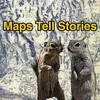
S5E26: Maps, Vanished Lakes, and Two Desert Squirrels
We think of range maps as static representations of where plants and animals belong. It doesn't often occur to us that maps are just snapshots of a constantly changing world. In the Mojave Desert, two sister species of desert ground squirrel coexist nearly side by side. A field guide's range maps will tell you where those species live right now. But those maps also convey hints out of Deep Time, and those hints can explain not only why the squirrels live where they do, but also how the two species evolved in their own directions. Host Chris Clarke shares the story of those sister species: the Mohave and Round-tailed ground squirrels. One is doing well and is abundant. The other has been designated as a threatened species. Each of them is a library of history... if we know how to read them. Chris also announces the launch of our Fellowship for Desert Reporting: prospective Fellows can start by filling out the application form at https://thedamn.org/fellowship-application. Resources Mohave ground squirrels California Department of Fish and Wildlife: Mohave Ground SquirrelSpecies overview, conservation status, recordings and access to the state conservation strategy.CDFW Mohave Ground Squirrel Philip Leitner, “Current Status of the Mohave Ground Squirrel: An Update Covering the Period 2013–2020”Reviews the animal’s current distribution, apparent losses from portions of its historical range and continuing conservation concerns.Status update PDF Mohave Ground Squirrel Technical Advisory GroupCDFW’s archive of technical documents and meeting materials from researchers, agencies and other specialists.Technical Advisory Group Mohave Ground Squirrel Conservation Council: PublicationsA bibliography covering the species’ taxonomy, ecology, genetics, distribution and conservation.Publications list Separation, contact and hybridization Kayce C. Bell and Marjorie D. Matocq, “Regional Genetic Subdivision in the Mohave Ground Squirrel: Evidence of Historic Isolation and Ongoing Connectivity in a Mojave Desert Endemic”Animal Conservation 14 (2011): 371–381. Examines genetic structure and historical isolation within Mohave ground squirrel populations.Article and abstract Philip Leitner, Jennifer S. Rippert and Marjorie D. Matocq, “Genetic Structure Across a Contact Zone Between Xerospermophilus Ground Squirrels in Southern California”Western North American Naturalist 77 (2017): 152–161. Documents both species and genetically admixed animals near Hinkley. It also reports expansion across the former barrier of no more than approximately 30 kilometers—an average of no more than five meters per year.<a href="https://scholarsarchive.byu.edu/wnan/vol77/iss2/2/?utm_source=chatgpt.com" data-start
Podzilla Summary coming soon
Sign up to get notified when the full AI-powered summary is ready.
Free forever for up to 3 podcasts. No credit card required.
Listen to This Episode
More from 90 Miles from Needles: the Desert Protection Podcast
S5E30: Why Deserts Need Defending
S5E29: Why Was the North Kaibab Trail Still Open?
S5E28: 4 Things You Need to Know about Desert Flooding
S5E27: Sonoran Toads and the Dirty Business of Ego Death
Get summaries like this every morning.
Free AI-powered recaps of 90 Miles from Needles: the Desert Protection Podcast and your other favorite podcasts, delivered to your inbox.
Free forever for up to 3 podcasts. No credit card required.