Free Daily Podcast Summary
3 Wise DMs: Daily Summaries Delivered
by The 3 Wise DMs
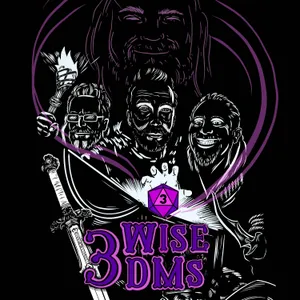
3 Wise DMs is a podcast for dungeon masters (for Dungeons & Dragons) and game masters (any other RPG) with problems. And when we say problems, we don’t mean the kind of things you find answers for in the gamebooks. Think of it as a gaming philosophy show with a strong emphasis on applied knowledge. We all want to be great DMs, so what do we do to try to get there?
Latest Episodes
The most recent episodes — sign up to get AI-powered summaries of each one.
- Sep 27, 202649 min
The DMs Code: What Do We Owe Our Players?
Does a good DM need a Code of Ethics? Long-time listener, Dr. DM himself, Jason, brings Tony, Chris, and Dave a question that reaches beyond rules and encounter design: when a player dominates the spotlight, cheats, crosses a boundary, or simply stops having fun, what responsibility does the DM have to act?The 3 Wise DMs discuss the DM’s influence over the table, the responsibilities players share, and the value of setting expectations before play begins. Along the way, Tony recalls a treasure dispute that went spectacularly wrong, while the group considers character agency, honest feedback, and Shadowdark’s “Pact” of goodwill, respect, and fellowship.2:45 Dr. DM’s question about a DM Code of Ethics.5:54 Spotlight sharing, cheating, and when a DM should intervene.7:58 DM Chris distinguishes table etiquette from professional ethics.11:58 The elegance of Shadowdark’s “The Pact.”14:15 Character conflict vs Player conflict.19:11 Curating your table.22:35 “Back in the Day with DM Tony”: Treasure gone wrong.27:07 Fairness, Session Zero, and a shared responsibility for the fun.29:43 Player agency: how to handle when a character’s goals are sidelined.37:23 Checking in with players: The Open Door Policy.40:15 Players responsibility for raising concerns with the DM.41:40 Final Thoughts.
- Sep 6, 202652 min
Fear of the Dark: 3WD Reviews SHADOWDARK!
Shadowdark promises old-school danger with modern rules: fast character creation, deadly combat, limited resources, unpredictable magic, and a torch that burns for one real-world hour. But how does it actually feel at the table?After running Shadowdark for the Doctor’s Blades’ latest expedition, Tony, Chris, and Dave sit down to examine what worked, what surprised them, and which parts of the system took some adjustment. From simplified mechanics and real-time resource pressure to spellcasting, encounter balance, and character survivability, the Wise DMs explore whether Shadowdark successfully captures the tension of classic dungeon crawling—and which ideas they may carry into their other games.Check out our previous jaunt into the world of the OSR!2:20 Why did the 3 Wise DMs decide to try Shadowdark?4:30 Old-school danger combined with modern game design.8:50 Fast character creation—and learning not to become too attached.11:35 Simple rules allow players to get “off their sheet.”15:45 The elegance of gear Slots and Torch Timer mechanics.21:10 Darkness, resource pressure, and making meaningful decisions.22:50 No one died died? How deadly is Shadowdark?27:25 Spellcasting without spell slots and the danger of losing a spell.34:40 What worked and what didn’t during the Doctor’s Blades adventure?46:23 Final thoughts.
- Aug 23, 202645 min
Can “Yes, And…” Go Too Far? Balancing Player Freedom and the Story
“Yes, and…” is one of the foundational principles of improvisation and is a powerful tool for any DM or GM to encourage creativity at the table. But does a good DM always have to say yes?In this episode, Tony, Chris, and Dave sit down to discuss what happens when player freedom begins pulling against the setting, the adventure, or the enjoyment of everyone else at the table (from DM Tony's kitbashed Curse of Strahd campaign). From unexpected character motives and disruptive choices to campaign boundaries and the DM’s responsibility to the world, the Wise DMs explore when to embrace an idea, when to redirect it, and when it may be necessary to simply say no.2:05 Can “Yes, and…” go too far at the gaming table?4:35 Improvisation may begin with “yes,” but that doesn’t mean every idea has to work.7:10 When “Yes, And…” comes at the expense of other players at the table.10:20 Establishing the boundaries of the world before the adventure begins.13:50 Player agency doesn’t mean freedom from consequences.17:15 Is the DM responsible for making every player idea work?21:05 Why would players not do something if it’s always worked?26:05 How the game system can assist with players who really love complete improv.29:05 Working with the players instead of allowing the game to become adversarial.33:10 The importance of tone, expectations, and getting everyone to play the same game.36:55 Final Thoughts.
- Jul 12, 202646 min
The Last Hit Point: How To Make Death Matter in Your TTRPGs
Few moments at the gaming table carry more weight than the death of a player character. Is it the ultimate consequence of failure, a dramatic turning point in the story, or simply an opportunity for the next chapter to begin?In this episode, Tony, Chris, and Dave tackle one of the oldest debates in tabletop gaming: how should DMs handle character death? From the evolution of death mechanics across editions to player agency, storytelling, and the ever-present threat of the dreaded Total Party Kill, the Wise DMs explore how death can shape both the game and the stories we tell together.2:15 A listener question from a returning special guest!4:55 Is it harder to kill a PC in 5e than other editions? Absolutely.7:40 The time invested in creating a character has increased and the game has evolved with it.8:30 Tension is increasing with everything leading up to death. Once a character dies, the tension is gone.10:50 Does death mean that the story is over? Providing player agency to what happens with death.11:55 There’s a difference between Gauntlet and Skyrim – meatgrinding vs story.19:05 “We all win when we tell a good story.” What’s the story that your game is telling?24:55 Mechanics don’t appear from the ether. They spring from playing the game and wanting to experience new things.30:12 Total Party Kill vs Total Party Capture – which is more thrilling?31:30 Permadeath is rare in most fantasy settings.39:45 Final Thoughts.
- Jun 21, 202645 min
I Can't Explain: Does Your D&D Adventure Need To Make Sense?
Books, movies, and television shows benefit from one major advantage: the entire story is planned before the audience experiences it. D&D campaigns don't have that luxury.Players miss clues, chase unexpected leads, ignore carefully crafted plot hooks, and sometimes decide that the villain's plan sounds surprisingly reasonable. As a result, even the most carefully prepared campaign can become a tangled web of stories, side quests, and unanswered questions.In this episode, Tony, Chris, and Dave tackle a question that arose during Chris's ongoing Lord of the Rings campaign: How important is it for every plot thread, mystery, and adventure to fit together into a perfectly coherent story?Along the way, the Wise DMs explore the balance between narrative consistency and table enjoyment, discuss when loose ends are worth tying up, and ask a fundamental question: Is it more important for your campaign to make sense—or for everyone at the table to have fun?1:37 Our congratulations to The New York Knicks and New York city!3:22 DM Chris’ question regarding his Middle-Earth campaign.4:48 Continuity is important. 5:58 DM with a Day Job’s YouTube video: Stop Connecting Everything!7:30 This question can change when you’re playing in worlds like Middle-Earth.9:05 “Sometimes a tomb is just a tomb.” Not everything is a reveal.11:05 Some campaigns are one long, epic adventure: LOTR and Dragonlance.12:30 Our discussion of the factions and innerworkings of Moria.15:30 You don’t have to explain anything until you have to explain it.20:15 Frequency of Play.22:58 Your players are focused more on explaining their characters rather than explaining the adventure.25:00 Lore heavy campaigns.26:54 The evolution of storytelling in TTRPGs.29:48 Paying homage to well-loved properties.32:23 The longer you have between sessions, the more your mind will find all the “plot holes.”36:35 Final Thoughts.
- Jun 7, 202651 min
Turn Slogs into Showdowns: Making Memorable and Epic Finales for Your D&D Campaign
Some listener questions come in and just HAVE to be answered. This was the case with a question that came in from longtime friend of the show, Dr. DM himself, Jason. His son’s school D&D club was planning a seriously epic finale to multiple campaign tables in a stupendous one-shot. Everything was gong well until the head DM brought their BBEG… we’ll let Jason tell you the rest.In this episode, Tony, Chris, and Dave sit down to discuss what makes a good finale, a good BBEG, and best practices for collaborating with multiple DMs. Not surprisingly, it always comes down to communication. 1:50 Dr. DM’s question about an insane BBEG for his son’s school D&D Club Finale.7:00 The concept of the finale game sounds AWESOME! But if you’re doing a collaboration, you have to collaborate.8:45 Benchmarking when creating homebrewed monsters.10:00 The BBEG should matter in each of the separate campaigns storylines.11:05 In our Curse of Strahd finale, the players mowed through 2000 hit points in a session… that’s still 128,000 to go.14:25 Monsters aren’t just bags of hit points to soak up damage.20:30 With collaborative storytelling, keep lines of communication open. 22:15 Encounters and finales are meant to be challenging and epic… not impossible. Make it so that they have to really think their way through the encounter, not just swing their biggest attack every time.30:05 In the end, it’s always about communication around the table and behind the screen.31:55 What is the theme and story for the finale?34:15 “Appropriately-Sized Encounters.” If there is no win condition, then you’re just whipping on your players.37:35 A finale, even if it spans different worlds, should matter to the players in each of their individual campaigns as well.40:15 A campaign that wipes in a TPK isn’t necessarily as cool as you think it might be.43:00 Final Thoughts.
- May 24, 20261h 3m
Two DMs Share Best Tips To Combine Call of Cthulhu and D&D into One Adventure!
Birthday games are 3WDs specialty… and it has now begun to grow. New DMs are joining in on the fun and running new, unique, and exciting games in all types of systems and taking on the challenge of one-upping the Wise DMs.In this episode, Tony, Chris, and Dave sit down with returning guests, Bonnie and Elizabeth, to review, unpack, and discuss the steps they took to take a one-off Call of Cthulhu investigation from last year and transform it into a massive 9-player adventure that spanned both Call of Cthulhu and D&D! For anyone that has ever thought of mashing systems and players together… this is the episode for you!2:00 The 3 Wise DMs review the overall experience.3:45 Our Guest DMs, Bonnie and Elizabeth, provide the high overview of approaching a large adventure combining 2 separate systems.9:35 The inciting incident for our current Investigation.16:15 Providing spotlight for all the characters.19:05 The power of narrative-focused TTRPGs.22:38 Time management in one-shots.30:50 Developing a mystery that will allow the players to discover it and NOT blow your clock budget.36:40 Bringing the tables back together for the finale and the “Psychology of the Sheet.”50:05 Final Thoughts.
- May 3, 202648 min
3 Wise DMs Reveal the 7 DM Styles To Make You Run The Best D&D Game Ever
Recently, Matt Colville of the Running the Game YouTube series and author of the new Draw Steel TTRPG, discussed the concept of “DM Style.” With someone who has been involved in all things tabletop for over 40 years, you would think that he would believe in developing a DM Style. However, his hot take was that he wasn’t sure there even was such a thing.In this episode, Tony, Chris, and Dave sit down to discuss DM Style: Is it a thing and, if so, what are the things that make it up. Along the way, we discuss how to take all these lists and types of DM Styles and make them work for you in putting together a better game.2:55 The flip side of the coin to Episode 7: The Eight Player Types.3:22 The first issue with DM Style: It probably changes with the group you’re running for.4:30 Lists can be helpful if they are prescriptive – not just descriptive.6:15 DM Style is a lot like Personality Tests: you’re a mixture of all the different metrics that keeps changing.9:55 DM Tony takes some inspiration from his MBA Program “Back in the Day…”15:00 Management “styles” read more like DM Style metrics: Autocrat, Laissez-Faire, Democratic, Collaborative, Inspirational, Strategic, Results-Oriented.18:00 The idea of “DM Signature” as opposed to “DM Style.”20:00 These metrics, or dials, are always being adjusted – even in real-time during the game.22:15 DM Chris’ 5 Metrics: Rules, Story Focus, Session Style, Prep, and Conversation Style.25:15 Does “DM Style” change with the system you’re running?27:15 The DMs character: the World. We return to the 8 Player Types.37:07 “Are You Not Entertained?” Fun Gameplay supersedes rules, styles, and the like.40:45 Final Thoughts.
Get 3 Wise DMs summaries in your inbox
Free AI-powered daily recaps. Key takeaways, quotes, and mentions — in a 5-minute read.
Get Free Summaries →Free forever for up to 3 podcasts. No credit card required.
You Might Also Like
Listeners also like.
Dumb-Dumbs & Dragons: A D&D Podcast
A group of improvisers new to roleplaying adventures through Dungeons & Dragons with comedic results.
My First Dungeon
Many Sided Media
Dungeons and Daddies
Four fathers navigate a magical realm in a Dungeons & Dragons campaign to save their missing sons.
Lawful Stupid - A DnD 5e Actual Play Podcast
Lawful Stupid DnD

Not Another D&D Podcast
A comedic actual-play D&D podcast following a group of friends adventuring through fantastical realms.
Critical Role & Sagas of Sundry
A band of heroes battles dark forces in the realm of Exandria in this epic tabletop role-playing adventure.
Critical Role
A group of voice actors play tabletop roleplaying games, blending storytelling and improvisation in epic fantasy campaigns.
SitcomD&D
A group of friends play Dungeons & Dragons with a sitcom twist, following tavern-owning adventurers in self-contained comedic episodes.
Tales from the Stinky Dragon
A group of friends play Dungeons & Dragons in a comedic, immersive audio adventure filled with quirky characters and fantastical quests.

Legends of Avantris
A group of friends improvises comedic and dramatic stories in a shared fantasy world, blending roleplay, voice acting, and playful banter.
The Glass Cannon Podcast
A group of comedians and actors play tabletop role-playing games with improvised humor and immersive storytelling.
RPG Major: Actual Play RPG Mystery & Improvised Musical Theater
RPG Major
About 3 Wise DMs
3 Wise DMs is a podcast for dungeon masters (for Dungeons & Dragons) and game masters (any other RPG) with problems. And when we say problems, we don’t mean the kind of things you find answers for in the gamebooks. Think of it as a gaming philosophy show with a strong emphasis on applied knowledge. We all want to be great DMs, so what do we do to try to get there?
Customized Recaps
AI-powered recaps with compact key takeaways, quotes, and insights.
Straight to Your Inbox
Get key takeaways from 3 Wise DMs in a 5-minute read.
Save Hours Every Week
Stay current on your favorite podcasts without falling behind.
Frequently Asked Questions
What is Podzilla's 3 Wise DMs daily summary?
It's a free AI-powered email that summarizes new episodes of 3 Wise DMs as soon as they're published. You get the key takeaways, notable quotes, and links & mentions — all in a quick read.
How does the 3 Wise DMs podcast summary work?
When a new episode drops, our AI transcribes and analyzes it, then generates a personalized summary tailored to your interests and profession. It's delivered to your inbox every morning.
Is this an official 3 Wise DMs product?
No. Podzilla is an independent service that summarizes publicly available podcast content. We're not affiliated with or endorsed by The 3 Wise DMs.
Can I get summaries of other podcasts too?
Absolutely! The free plan covers up to 3 podcasts, any in the catalog. Basic raises that to 15, Pro to 40 and Max to 100. Browse our full catalog at /podcasts.
How often does 3 Wise DMs release new episodes?
3 Wise DMs publishes biweekly. Our AI generates a summary within hours of each new episode.
What topics does 3 Wise DMs cover?
3 Wise DMs covers topics including Leisure, Education, How To, Games, Hobbies. Our AI identifies the specific themes in each episode and highlights what matters most to you.
Start getting 3 Wise DMs summaries tomorrow morning.
Free forever for up to 3 podcasts. No credit card required.
Free forever for up to 3 podcasts. No credit card required.